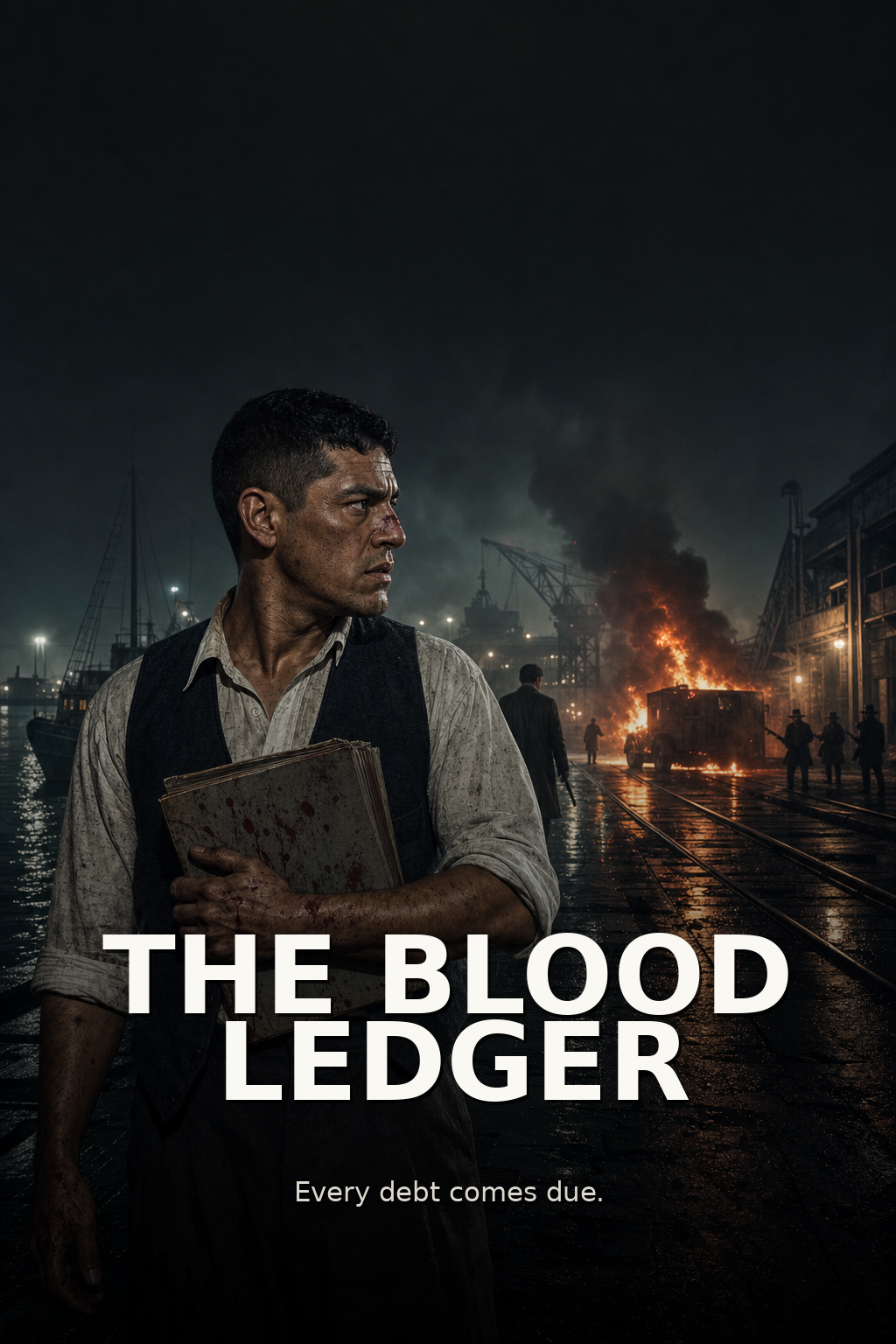
Inside the Dramatica Narrative Platform
One random Storyform.
A whole story
to make your own.
A Storyform is a snapshot of an entire story, all at once: how it begins, how it ends, and how it gets there.
Watch a writer combine one with an idea and a series of choices to develop The Blood Ledger—a thematically rich, 28-scene outline with Narrova. All in less than 2 hours.
See how the story took shapeDramatica helps you think through a complete story.
You write the finished screenplay or novel.
00 / Before the conversation
The whole story comes first.
The writer opened the Storyform Builder, a tool within our platform, and selected a Storyform completely at random from 32,768 possibilities. No premise, character names, or scenes had been chosen for it.
That selection supplied a connected pattern of conflict and thematic exploration. The writer would supply its world, people, and meaning through Storytelling. The same Storyform could become many different stories.
A shared effort.
A personal trap.
The group tries to obtain something (OS Signpost 1: Obtaining). The central character feels their situation tightening (MC Signpost 1: Progress).
Actions force
the next move.
Actions force decisions (Story Driver: Action). The effort moves from gathering information (OS Signpost 2: Learning) to finally understanding what is going on (OS Signpost 3: Understanding). Available options run out (Story Limit: Options).
The effort fails.
The hurt remains.
The Main Character holds to their approach (MC Resolve: Steadfast). The shared goal fails (Story Outcome: Failure), and their personal anguish remains unresolved (Story Judgment: Bad).
OS means Objective Story; MC means Main Character. These labels name the exact appreciations in the selected Storyform. The harbor robbery, foster brothers, and final plunge into the water were developed afterward.
You can start with an idea, too. Random selection was this writer’s experiment. Here, it gave the conversation a complete structure to explore from the outset.

Four views of one story
The robbery is only
part of the story.
Early in the conversation, the writer used Narrova to establish the shared heist, the dockworker’s personal struggle, the bookkeeper’s challenging perspective, and the brothers’ relationship. Those choices gave the development to come its context.
Dramatica calls these four connected views Throughlines. Select one to see what it contributes. Together, they connect plot, personal struggle, another perspective, and the relationship between people.
These four Signposts identify the thematic territory to explore in this Throughline across the story’s four Acts. The Storyform already includes the ending; each Signpost helps you develop how the story gets there.
01–08 / The actual conversation
Eight prompts.
A story taking shape.
Each step below shows what the writer asked, what Narrova delivered, and how it pays off later. Open the original exchange to inspect the full wording.
Each step includes an estimated working time: Narrova’s processing, the writer’s input, and one read of the response. The full example comes to approximately 97 minutes—under two hours, with breaks excluded.
The deliverable / Explore every scene
A place to begin writing.
Twenty-eight saved scene cards, each with a setting, synopsis, and required events. Select a scene to read its actual saved content. Filter by Throughline to see how the personal and relationship story joins the heist.
Each dot is a scene carrying that Throughline in the final coverage map. Vertical lines mark the five turning actions. Filtering highlights one view of the same complete story.
Scene content is taken from saved Moment records. Structural labels are reproduced from the conversation’s final coverage audit. A scene can carry more than one Throughline; the labels explain its work in the story.
Open the complete, printable outline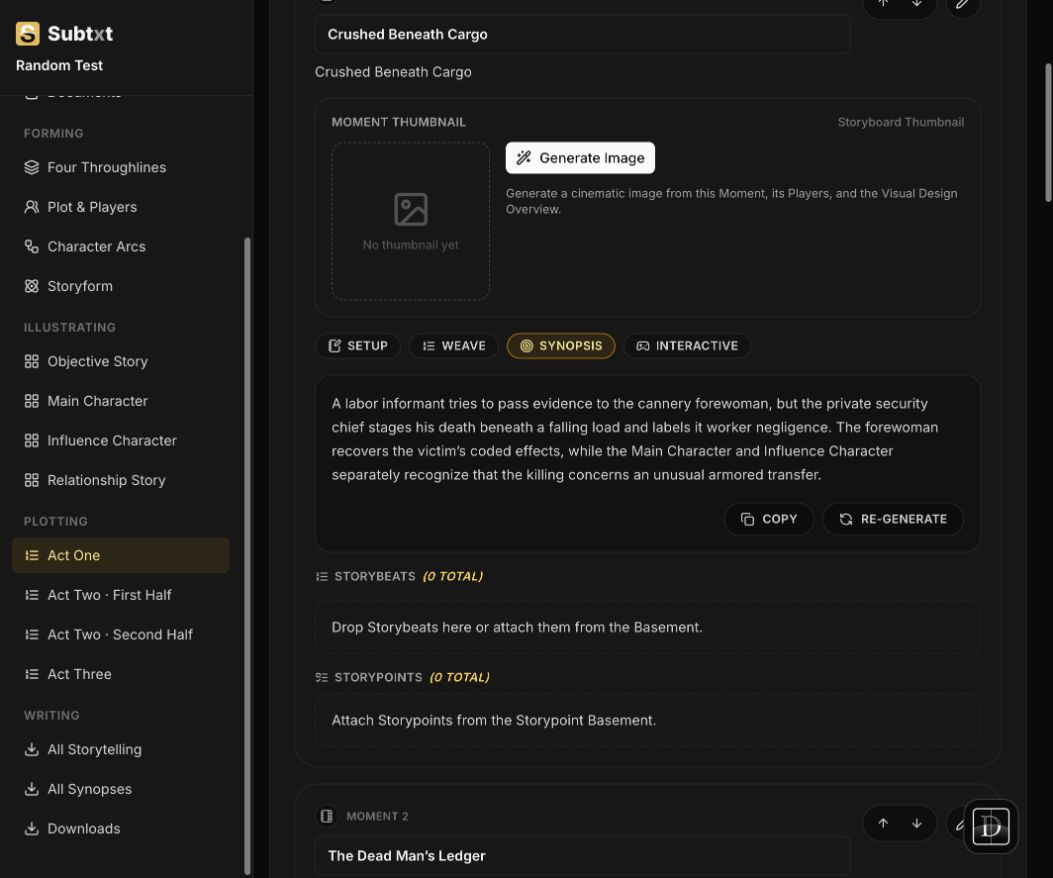
Eight people / Competing needs
Characters you can put
on the page.
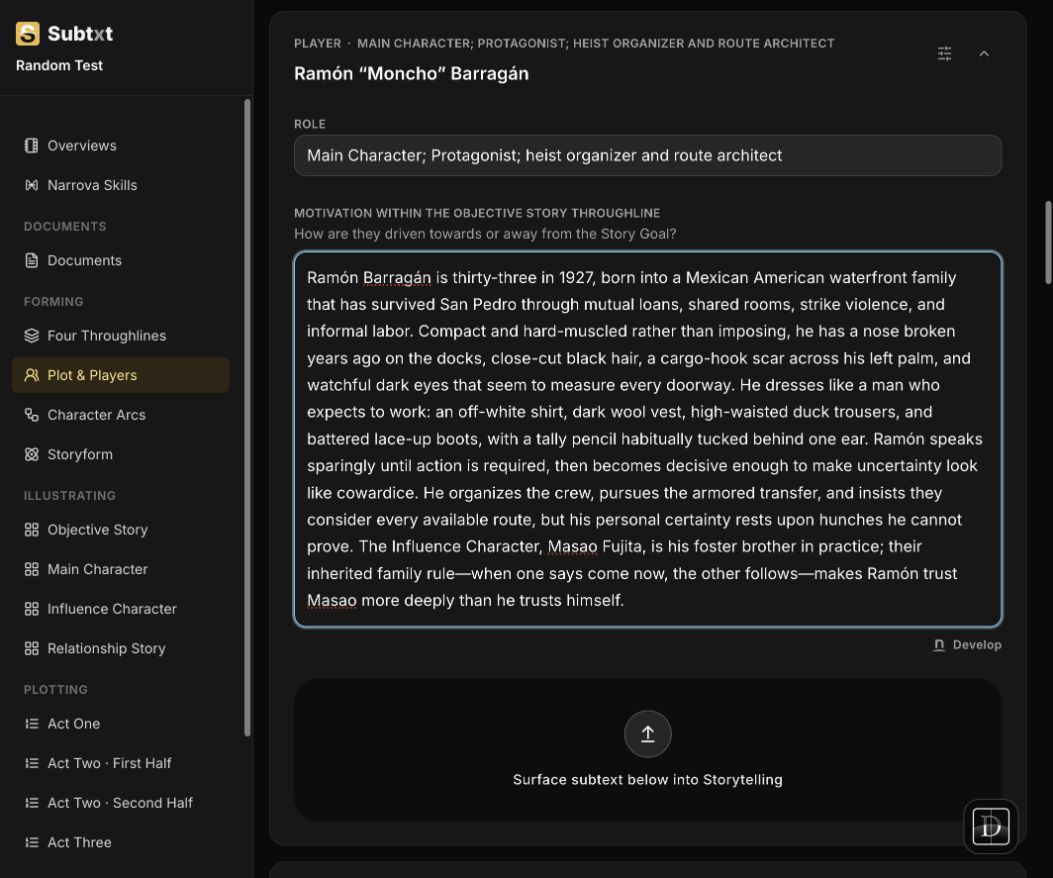
Open a name to see the saved character description. Their functions explain how they affect the group’s effort; their lives give you people to write.
One choice, carried to the ending
“Something to rely on”
becomes what it costs.
Make them family.
The writer asks for a bond beyond race and status. Narrova develops foster brothers whose fathers helped each other survive.
Test what brothers owe.
A childhood rescue promise becomes a dispute over who gets to decide what saving the other person means.
Survival leaves a debt.
Both brothers survive. The ledger and payoff are lost. They escape as hunted men whose families must deny them.
The theme becomes something people do to one another. The outline gives you the scenes in which to make the audience feel it.
Time to a complete outline
A story package.
Under two hours.
The conversation ran across September 6–7, 2026. Its long breaks are excluded below. Processing time is measured; time spent typing, reading, and deciding is estimated.
| Step | Narrova time | Input estimate | With reading & input |
|---|
How the timing was calculated
Make room for your next story
Develop your story
in this much depth.
Basic lets you explore the ideas. For the sustained detail and insight shown in this walkthrough, Plus and Pro provide a practical allowance for developing complete outlines.
These are approximate examples based on this conversation, without purchased resets. Your pace, model choice, research, and revisions affect how many outlines you can develop. Plus refreshes monthly; Pro’s monthly estimate assumes work spread across its weekly refreshes. Basic supports exploration at a smaller scale; Plus and Pro are the practical choices for this depth of development.
Your voice. Your choices. A complete story.
Now you can
write the first scene.
Open on a fogbound freight shed. A worker tries to pass evidence to the forewoman. A load falls. The official explanation arrives too quickly.
You know what happens, what it sets in motion, and why it matters to the ending. The dialogue, images, rhythm, and finished pages are yours to write.
Develop your story with Dramatica