Dramatica Q&A: Mapping Character Want and Need Across Story Systems
Want to translate “Want vs. Need” into Dramatica terms without losing the simplicity of the original question? This quick Q&A keeps the shorthand, but maps it to the Storypoints Dramatica actually uses.
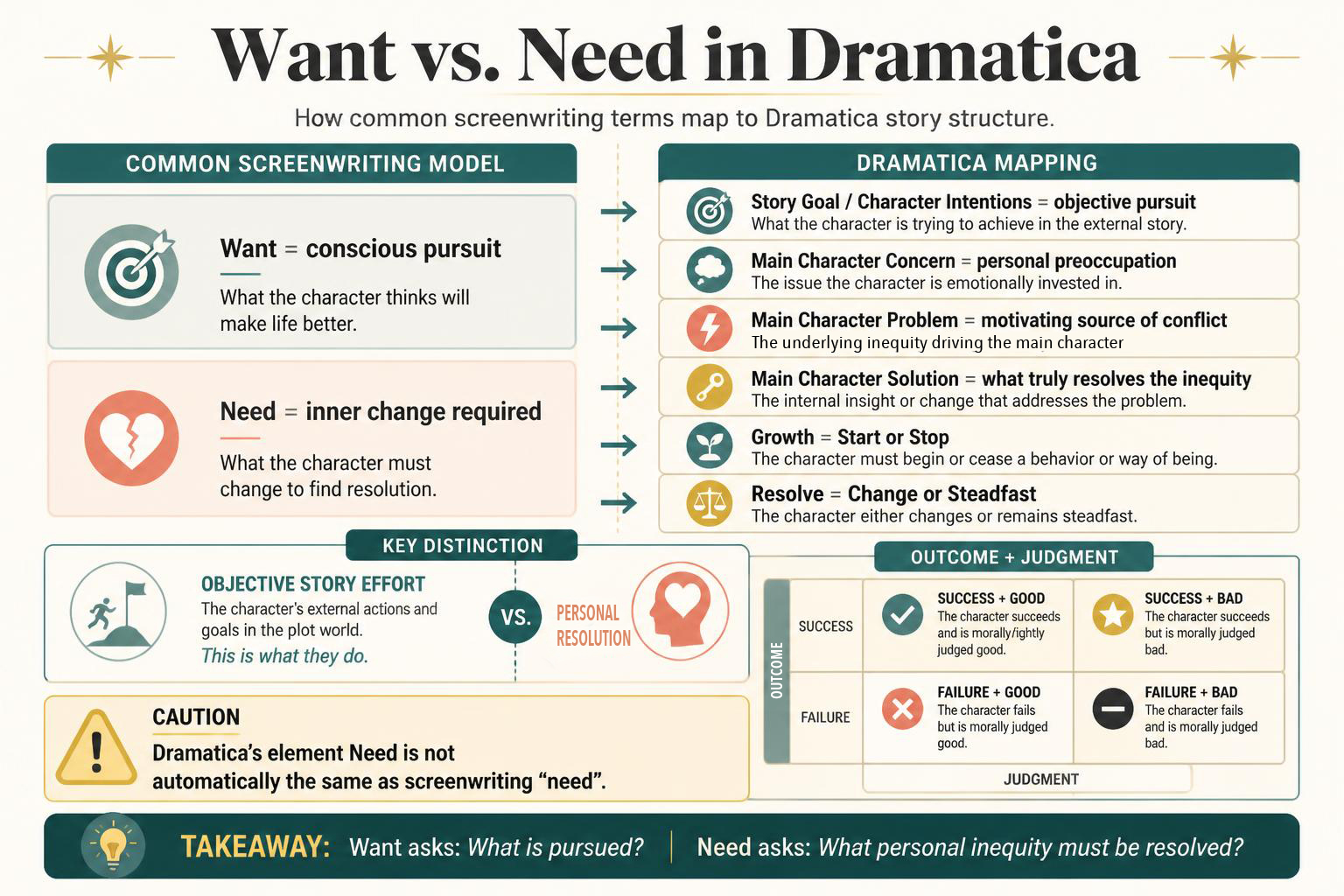
Want to translate “Want vs. Need” into Dramatica terms without losing the simplicity of the original question? This quick Q&A keeps the shorthand, but maps it to the Storypoints Dramatica actually uses.
Question:
How do Truby’s / Vogler’s / Snyder’s character’s “Want” and “Need” paradigm map to Dramatica’s understanding of story
Short version
Truby/Vogler/Snyder’s “Want vs. Need” is usually a two-layer character model:
- Want = what the character consciously pursues.
- Need = what the character must learn, become, accept, abandon, or embody to be whole.
Dramatica does not treat that as one simple binary. It splits those ideas across different perspectives of the storymind.
The practical mapping
| Want/Need model | Rough Dramatica equivalent | Plain-language translation |
|---|---|---|
| Want | Story Goal / Character Intentions | What everyone, or the Protagonist function, is trying to achieve in the larger plot. |
| Want | Main Character Concern | What the Main Character is personally preoccupied with. |
| Want | Motivation / Problem element | The drive pushing the character, which may be misguided or productive. |
| Need | Main Character Solution | The counterbalancing quality that would truly resolve the Main Character’s personal inequity. |
| Need | Main Character Growth: Start or Stop | Whether the character needs to begin something missing or stop something excessive. |
| Need | Resolve: Change or Steadfast | Whether the character must abandon their viewpoint or hold to it. |
The big Dramatica distinction
In many screenwriting systems, Want is “external” and Need is “internal.” Dramatica is more precise:
- The Story Goal / Character Intentions tracks the objective effort: Did the larger story effort succeed or fail?
- The Main Character Problem/Solution tracks the personal inequity: Did the Main Character resolve what was really troubling them?
- Story Outcome answers the Want question: Success or Failure?
- Story Judgment answers the Need question: Good or Bad?
So a story can have:
- Success + Good: they get what they want and resolve what they need.
- Success + Bad: they get the want but remain personally broken.
- Failure + Good: they lose the want but gain personal resolution.
- Failure + Bad: they lose both.
Important caution
Dramatica also has a specific element called Need, but that is not automatically the same thing as Vogler/Snyder/Truby’s “character need.” In Dramatica, “Need” is one possible thematic/elemental item among many. The broader screenwriting “Need” more often maps to the Main Character Solution, Growth, Resolve, and Judgment working together.
Best takeaway
Think of Want/Need as a useful storytelling shorthand. Dramatica expands it into a diagnostic system:
Want asks, “What is being pursued?”
Need asks, “What personal inequity must be resolved?”
Dramatica then asks, “From whose perspective, by what method, and with what final judgment?”