Stop Asking Holistic Stories for a Goal They Were Never Built to Have
Why Dramatica now presents both Plot-focused and Character-focused terminology, and how Train Dreams makes the need for that shift unmistakable.
One of the fastest ways to misread a story is to force it to answer the wrong question.
For years, I watched writers bring me elegant, deeply human narratives and then freeze when the software asked: “What is the Story Goal?” They weren’t blocked because they didn’t understand their story. They were blocked because the lens was wrong. A linear lens can be brilliant for linear-minded problem-solving, but when a story is truly holistic in its logic, “goal/consequence” starts to feel like translation loss.
That mismatch has been in Dramatica discourse for a long time, even when nobody wanted to name it directly. So yes, this is partly a terminology update. But more than that, it’s an honesty update: no more forcing holistic narratives to explain themselves in linearly comfortable language, and no more man-splaining Dramatica theory to writers whose stories are clearly operating on a different mental model.
Where This Started for Me
Back in my story development consultant days, this pattern showed up constantly in sessions. A writer would present a story with strong emotional architecture and clear movement, but as soon as we pushed it through classic Problem/Solution and Goal/Consequence prompts, everything flattened. The structure was there. The language wasn’t.
Subtxt made that impossible to ignore. Once we could see enough storyforms at scale, the split became obvious: linear stories thrived under goal/consequence framing, while holistic stories often revealed themselves more accurately through intention/repercussion and through resistance/flow dynamics. Same underlying structure, different cognitive entry point.
That is not a soft preference issue. It changes whether a writer feels seen by the tool or corrected by it.
The Collaboration That Brought It Together
The merger of Narrative First and Write Brothers gave us a rare chance to do this right, not as a side glossary, but as a coherent shared language. I got to collaborate directly with Dramatica co-creators Chris Huntley and Melanie Anne Phillips to evolve my earlier terms into a tighter set that remains theory-aligned while actually matching how holistic writers experience story.
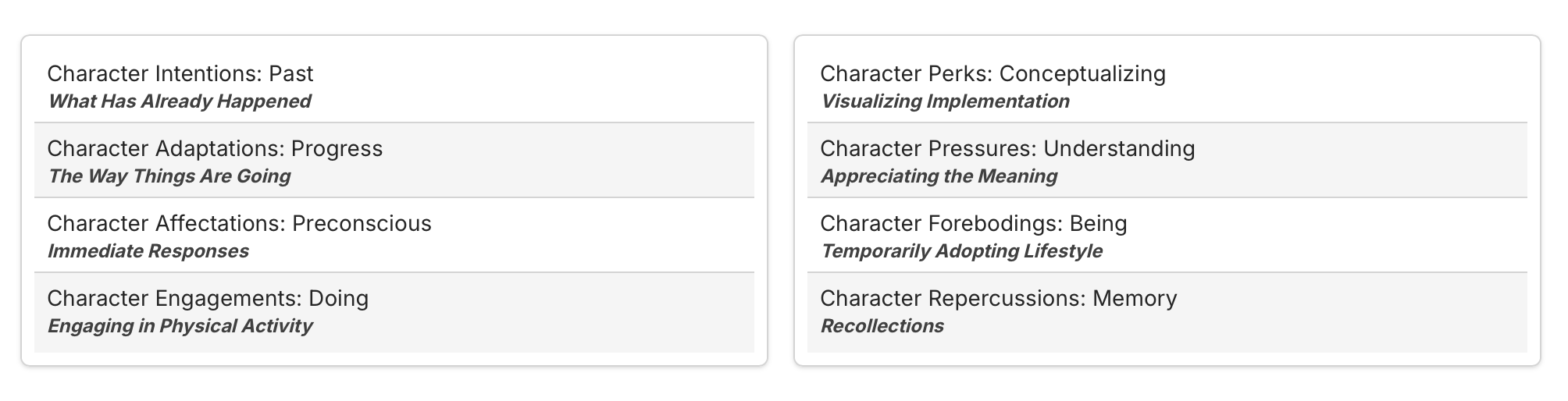
The key shift is straightforward: we now distinguish OS/Plot-focused framing from MC/Character-focused framing without changing the canonical storyform underneath. So the model remains stable, but the presentation can meet the writer where they are. “Story Goal” and “Character Intentions” are now two ways of viewing the same structural appreciation, not two competing theories.
That distinction matters because it keeps rigor and usability in the same room.
Why Train Dreams Makes This So Clear
If you ask Train Dreams for a shiny external “goal,” you get an answer that feels technically plausible and artistically wrong. But if you ask what intention is being lived through, the story opens up immediately: a man trying to live with what has already happened, as history, as grief, as landscape, as memory.
“Collectively, everyone saw the story’s intention as dealing with what has already happened–personally, historically, and environmentally–rather than chasing some shiny future objective. The ‘they’ story keeps circling back to earlier choices and events: the building of the railroad, the cutting of the forest, the way people and communities were treated, the fire, the loss of Robert’s family. The sense in the room was that what everyone is really doing–working the land, trying to make a living, pushing deeper into the woods–is struggling to live with and make sense of that accumulated past. The drive of the story is toward recognizing and coming to terms with where all of this came from and what’s been done.”
– Train Dreams analysis workshop notes (Dramatica Users Group)
Now look at the other side of that same dynamic:
“On the flip side, the group tied the ‘overwhelm’ to memory: if that intention of living with and integrating the past isn’t met, everyone ends up buried under the weight of what they remember. You all pointed to how Robert is flooded by images of his wife and daughter, by dreams and half-hallucinations, by stories told around campfires and on bridges–memories that hit him ‘like a branch that was meant for me.’ Those recollections don’t just sit there; they shape how he feels about himself and the world. So the consequence the story holds over everything is this: fail to reconcile with the past, and you’re left haunted and constrained by memory, replaying loss and damage instead of moving freely through the present.”
– Train Dreams analysis workshop notes (Dramatica Users Group)
That is exactly why “Character Intentions: Past” and “Character Repercussions: Memory” read as precise, while “Story Goal/Story Consequence” can read as oddly blunt for this particular narrative texture.
If you want to see the full community walkthrough, here’s the Dramatica Users Group analysis of Train Dreams.
The broader plot context supports this framing too: this is a life lived across labor, loss, environmental change, and recollection, where meaning is accumulated and revisited rather than won in a single decisive push. In that shape of story, “intention/repercussion” does a better job describing the actual dramatic pressure than a generic objective finish line.
What This Means Going Forward
This is not a rebellion against Dramatica. It is Dramatica, rendered with better fidelity for both cognitive styles.
Linear storytellers can keep using Plot-focused language. Holistic storytellers can work in Character-focused language that reflects how they actually process conflict and change. Same structure, cleaner access, better diagnostics, fewer false negatives in development.
And importantly: this is already reflected in the protocol layer. We’ve updated Narrative Context Protocol (NCP) to support these terms so tools, agents, and storyform workflows can stay structurally consistent while speaking the right language for the writer in front of them.
Links Mentioned
- Dramatica Users Group analysis of Train Dreams: https://platform.dramatica.com/video/bff9c34c-c63d-46e4-839c-05500a59effc
- Narrative Context Protocol (NCP) on GitHub: https://github.com/narrative-first/narrative-context-protocol