Does Your Story Really Have Two Protagonists?
A captain leads a rescue. A man who once falsified medical records lives with the guilt. When ChatGPT calls that an unclear protagonist, a second read with Dramatica gives the writer a reason to keep them both.

What would you do if a highly advanced AI model responded to your request to review a draft with this:
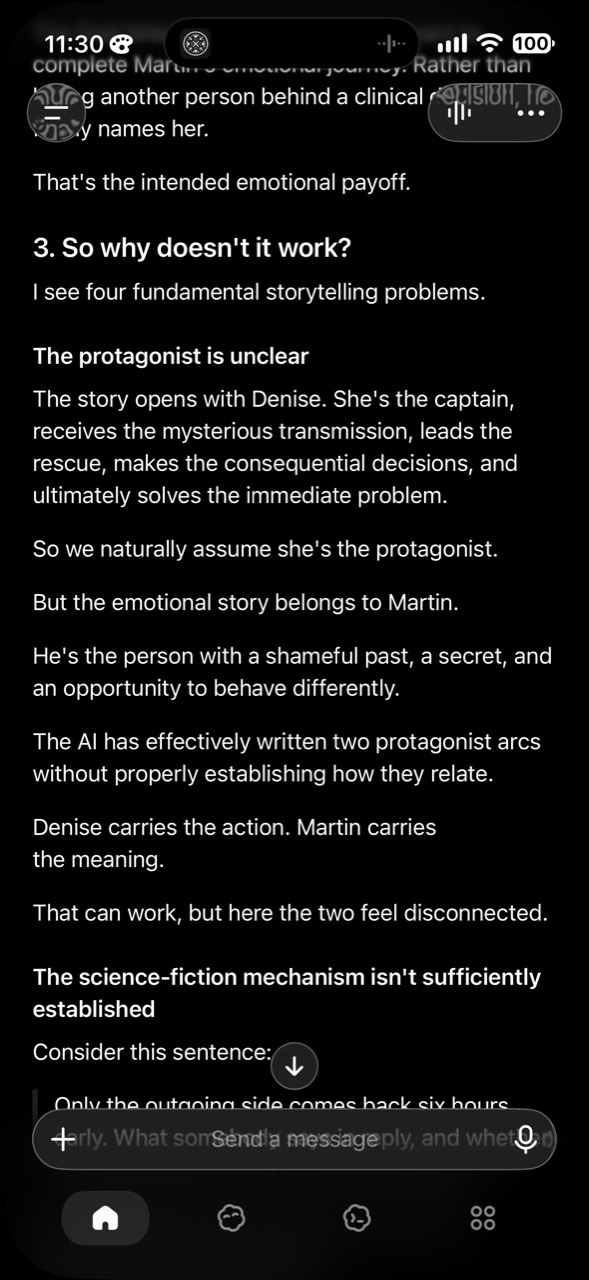
“You have written two protagonist arcs without properly establishing how they relate.”
That’s the gist of ChatGPT’s first note to us on our example story Dead Channel. A captain named Denise picks up a mysterious transmission. Her crew has witnessed people die, and now she has a chance to lead a rescue that could prevent those deaths. Martin is the man who once falsified medical records. By the end of the story, he can finally bring himself to admit his mistake regardless of what it means for his future.
It’s easy to read that note from Chat and start wondering which character should carry the story. Give Martin command of the rescue, or give Denise the secret Martin’s been keeping. Either way, you could spend a weekend getting those two jobs into one person. What in the story actually calls for that change?
ChatGPT picked up on both threads. Under the heading “The protagonist is unclear,” it wrote, “The AI has effectively written two protagonist arcs without properly establishing how they relate.” It allowed that the split could work, though here the two felt disconnected. That feeling is worth listening to. What deserves a second look is the explanation for it.
For the second read, we selected Dramatica (through the official ChatGPT Plugin for Dramatica, an MCP) in the same chat and typed “what do you make of this”. ChatGPT had the same story in front of it. This time it could consult Dramatica about what each character was doing.
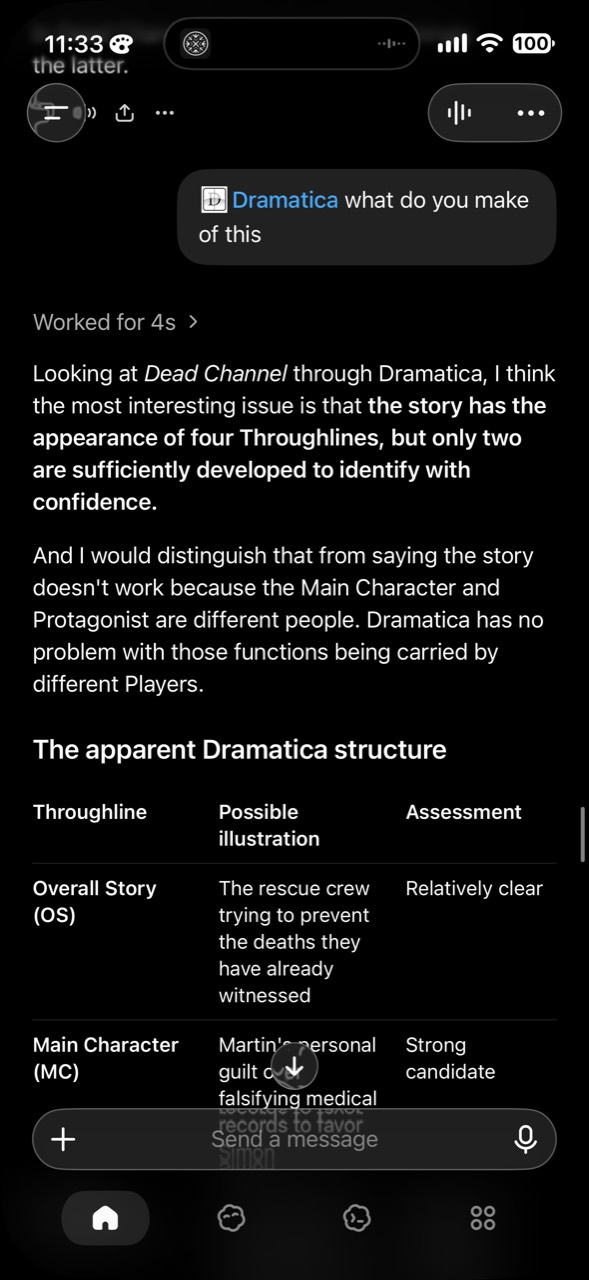
Seen from outside, everyone aboard has a stake in whether the crew can prevent those deaths. Dramatica calls that shared view the Objective Story. The Protagonist is whoever drives the pursuit of its goal. Denise has a good claim on that job. Now consider what it costs Martin to speak the truth he once hid behind a clinical decision. That’s an experience we can have from inside his skin. Dramatica calls the person who gives us that view the Main Character. You can put the reader beside Martin for that moment and still leave Denise in command.
The second read found enough on the page to recognize those two perspectives. It was less sure about two others. Who gives Martin reason to question the way he makes those decisions? And if a relationship matters to his story, what happens to the relationship itself? Dramatica calls each sustained view of the conflict a Throughline–the former would be the Influence Charater, the latter the Relationship Story Throughline. Of the four it looked for, the reply could make a confident case for two. That leaves the writer with something more interesting to investigate than which character gets top billing.
And all this was only possible because of the objective point-of-view provided by the Dramatica theory of story.
I’d go back to the moment Martin names her. Imagine two versions. In one, he’s alone when he says it. In the other, someone who signed off on his report is close enough to hear. The words can be identical. In the second version, two people now have to live with what’s been said between them. Which ending did you think you’d written? What happened earlier that would let a reader feel the difference?
That’s the kind of objective read we know writers need from a story tool. They can take Dramatica’s reasoning back to a particular scene, see how much of it holds up, and decide what I want the reader to experience there. Even the first note becomes more useful. A reader felt a disconnect. Now I have somewhere to look.
You can do this in the conversation where you received the note, even with the Dramatica app closed. Install the Dramatica plugin in ChatGPT and authorize it with an active Dramatica subscription. Once connected, select Dramatica or mention it by name. The MCP connection lets your assistant consult Dramatica’s theory directly. Claude and other compatible assistants can connect too. Connection guide · The original @DramaticaStory post
Next time a note has you thinking about a major rewrite, try asking, “Dramatica, what in my draft supports this note? Show me the moment that makes the strongest case for it, and tell me where you’re still guessing.” I’d want an answer to that before I took the captain’s chair away from Denise.