What’s Missing from Your Story?
A draft can have a strong opening, a clear ending, and plenty of action while its personal development remains incomplete. Plot Progression places the four Throughlines alongside one another so you can see what’s established, what remains uncertain, and where further writing might be needed.
You can feel when something is missing from a draft long before you can explain what it is. The opening works. The ending makes sense. Plenty happens in between. And yet, when you read the whole thing, something about the experience feels unfinished.
That’s a difficult place to rewrite from. You could add another confrontation, deepen a conversation, or invent a complication, but each possibility raises the same question: will this develop what’s missing, or just give you more pages?
Dramatica’s new Plot Progression workspace makes that question easier to answer. By showing the different parts of a story developing alongside one another, it gives the gaps a shape. You can begin to see where the action keeps moving while something personal, influential, or relational remains undeveloped or underdeveloped.
Our initial analysis of Alien: Romulus (2024) offers a useful example.
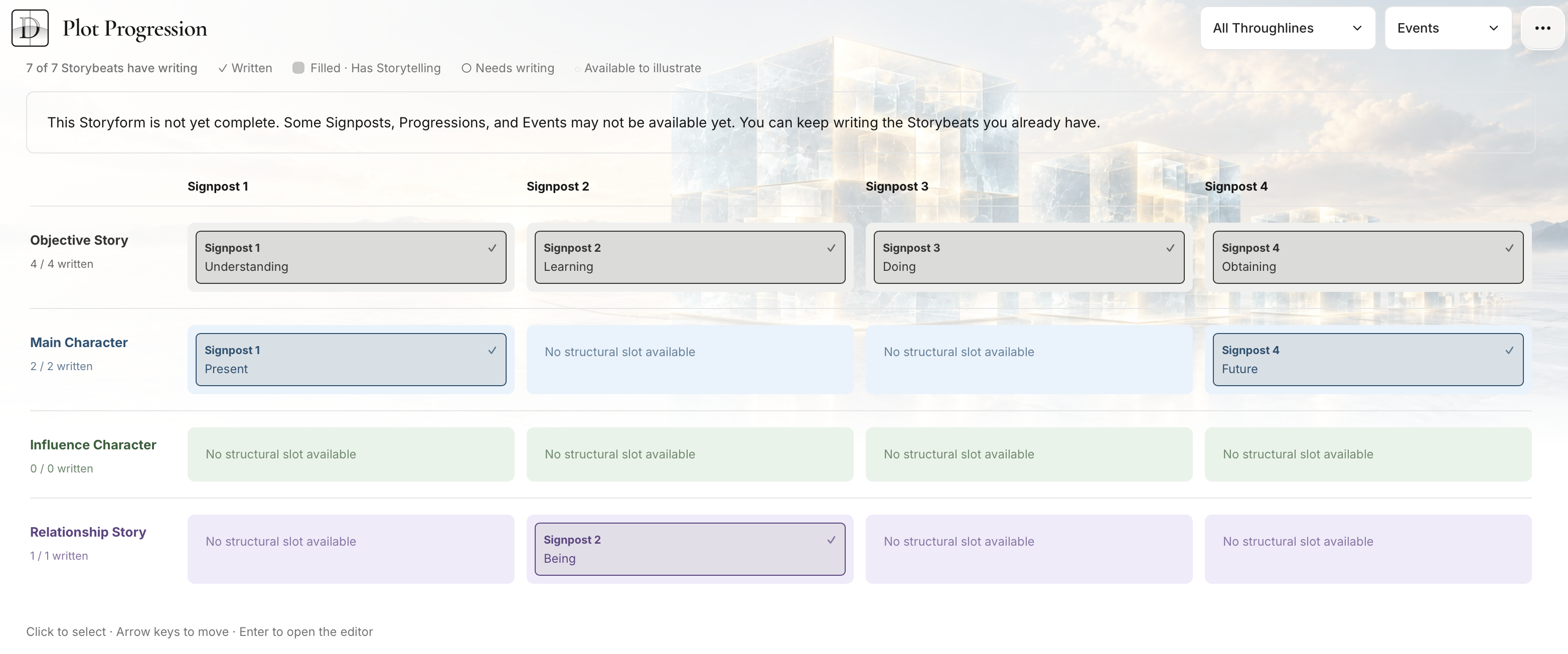
Four rows run across the workspace. Each represents a Throughline: a sustained way of experiencing the story’s conflict. The Objective Story follows the problems everyone is caught up in. The Main Character follows the personal experience of living through those problems. The Influence Character explores an alternative outlook that challenges the Main Character’s approach, while the Relationship Story follows what happens between them.
Across those rows are four Signposts, the major stages of development within each Throughline. Reading across lets you follow one part of the story from beginning to end. Reading down lets you see what the different parts are doing during the same broad stretch of the narrative.
And in this example, the unevenness becomes immediately visible.
Our initial analysis identifies all four Objective Story Signposts: Understanding, Learning, Doing, and Obtaining. We can trace a progression through the external conflict as the characters struggle to escape. That row has a recognizable beginning, middle, and end.
Rain’s personal development is much less complete in the analysis. Her first Main Character Signpost is Present: she confronts the reality of her circumstances when the company refuses to release her from its labor contract. Her final Signpost is Future: she commits to what lies ahead with Andy, despite the uncertainty of reaching her destination.
Between those two points, the row is empty.
The Influence Character row has no Signposts recorded at all. Andy is identified as the likely Influence Character, but we haven’t established a developed progression of the alternative outlook he brings into Rain’s life. The Relationship Story has one illustrated Signpost, Being, in the second position—the first half of Act Two—where Andy’s upgrade disrupts their familiar roles as brother, sister, protector, and dependent.
There’s enough here to suggest a structure. There’s also enough missing to show why we can’t confidently call that structure settled.
Why this Storyform is Unclear
A Storyform describes the underlying dramatic argument expressed through a story. Identifying one involves more than recognizing a few compatible moments. The different viewpoints and their development need to support a coherent reading of the whole.
That’s why this analysis is marked Unclear. We can recognize portions of a possible Storyform, but we haven’t identified enough fully developed material to confirm it. The empty areas are questions the analysis still needs to resolve.
They also require some judgment. A gap might mean we’ve overlooked something in the film. It might mean our proposed structural reading needs to change. Or it might point to development the story itself never fully expresses.
The workspace makes those questions visible without answering them prematurely. Its “7 of 7 Storybeats have writing” count refers to the seven Storybeats currently recorded. The surrounding gaps show how much of the larger progression remains unresolved.
For a writer working on a draft, that distinction is useful. You may have written every scene you planned and still have an underdeveloped personal journey. Seeing a beginning and an ending with no clear development between them gives you a much more specific problem to investigate.
Giving the middle something to develop
Suppose you were developing a story like this one. You’ve established a young woman trapped in circumstances she desperately wants to escape, and you know she’ll eventually choose an uncertain future with the brother she might otherwise have to leave behind. The creative question becomes: what happens between those positions that makes her final commitment meaningful?
One possible second movement could explore her Past. Imagine Rain discovering that an earlier opportunity to leave the colony depended on concealing Andy’s existence. She has always remembered staying behind as something circumstances forced on her. Confronted with evidence of her own decision, she has to face the resentment she’s carried toward someone she also loves.
That would give her personal history an active consequence. A scene could bring that conflict to life through an old application, a conversation she’s avoided, or a practical decision that repeats the earlier choice. What matters is that the past changes what leaving means to her now.
A possible third movement could explore Progress: whether her situation is actually improving. Rain gets closer to escape, but every apparent gain makes a life with Andy seem less attainable. She might secure passage for herself and realize that the measure she’s been using—distance from the colony—doesn’t tell her whether she’s getting closer to a life she wants.
That realization could lead her to sacrifice an immediate advantage to preserve the possibility of leaving together. Her eventual commitment to an uncertain future would then emerge from a personal conflict we’ve watched develop through the middle.
These are hypothetical rewrite directions, rather than claims about scenes in the film or confirmed assignments for its missing Signposts. Their order and structural fit would need to be checked against a coherent Storyform. But they show how a visible gap can generate a precise creative question—and how that question can become something a character actually lives through.
The same attention would still be needed elsewhere. Developing Rain’s middle wouldn’t, by itself, establish Andy’s Influence Character progression or complete the changing relationship between them. Each row gives the writer another way to examine what the story is expressing.
That’s the practical value of bringing a screenplay into Narrova. You can ask it to identify the most likely Storyform, explain the evidence, and illustrate the Signposts the draft supports. Plot Progression then gives you a place to examine that developing analysis: what’s established, what remains uncertain, and where further writing or a different interpretation might be needed.
A useful story analysis gives you a clearer idea of what to write next.
Sometimes that means recognizing material you already have and bringing it into focus. Sometimes it means reconsidering the structure you thought you were writing. And sometimes it means discovering that the personal experience connecting your opening to your ending has yet to find its expression.
Once you can see that space, you can begin imagining what belongs there: the encounter that changes what leaving means, the choice that makes an apparent victory feel unbearable, the moment another person becomes impossible to dismiss. The writer’s work is to give those possibilities a life on the page.