How We Test Frontier Models for Dramatica
Terra matched Sol’s average on two prose-revision tasks, but our model judge preferred Sol on 32 of 41 Storybeat development tasks. We evaluate the dramatic meaning behind the words as well as the writing itself.
Ask for help developing the relationship between two sisters, and you might get back two wonderful character descriptions. One avoids confrontation. The other needs to control everything. You can picture them at the same dinner table already.
But what happens between them?
Maybe the first sister asks for help, and the second makes the request a test of loyalty. Maybe a withheld piece of information turns every conversation afterward into an interrogation. Their individual habits are now changing their bond. The relationship has a life of its own.
A suggestion can be fluent, perceptive, and still miss that movement. It can also recognize the right structural idea while offering prose too vague to give the writer anything to work with. We test whether a model can do the particular work a story needs.
That standard guides our work on the Dramatica Narrative Platform. We ask models to help writers explore conflict, develop relationships, revise passages, and bring structural ideas into storytelling. Each task calls for a different kind of attention, and a graceful sentence still has to belong in this story.
OpenAI presents GPT-6.1 Terra as a model with strengths in clear, natural writing, including drafting and revision. That makes it an interesting candidate for a writing platform. It also gives us a question worth investigating: how much of that strength reaches the dramatic thinking behind a passage? Better writing might mean a cleaner sentence, a more natural voice, or a more fully developed story—and those improvements need their own tests.
Giving the models a story problem
On October 28, 2026, we ran one evaluation using three models: GPT-6.1 Sol, GPT-6.1 Terra, and GPT-6 Luna. Each received the same 52 tasks, with one response per model for each task, for a total of 156 generations. All three used high reasoning.
The tasks came from different writing needs. Throughline development explores one Perspective on a story’s conflict, such as a character’s personal struggle or a developing relationship. A Thematic Argument expresses what the story says about its central conflict. Illustration feedback examines how a writer has brought a structural idea into a concrete story example; revision and summary ask the model to preserve existing material while changing its expression or length.
Most of the tasks—41 of the 52—concerned Storybeats, which describe conflict as it develops over time, from a particular moment to a larger movement in the story. The other categories ranged from one to three tasks each, giving us a starting point for further investigation.
For those tasks, the models worked from a supplied Storyform: the underlying structural argument of a story. Each passage had a particular job, such as showing conflict arising from changing conditions or an investigation leading toward consequential action. We tested writing from supplied Storyforms; choosing or generating complete Storyforms was outside this run.
Each model received the same frozen Dramatica instructions for each task. The test compared those prompts directly, without live Narrova tools or hosted skill execution.
A separate, fixed model judge—GPT-6 Astra at high reasoning—reviewed the responses as anonymous samples with randomized labels. It scored writing for clarity, specificity, voice, craft, and usefulness. For the 41 Storybeat tasks, it also answered the questions in an existing 12-question alignment grader, which examines whether the storytelling fits its assigned meaning, movement, scope, and story perspective.
These are model-judged results from one response per task, not human preference or proof of statistical superiority. With 41 Storybeat cases and only a few in the other categories, we show the scores by task and sample size rather than treating a pooled average as the answer to every writing question.
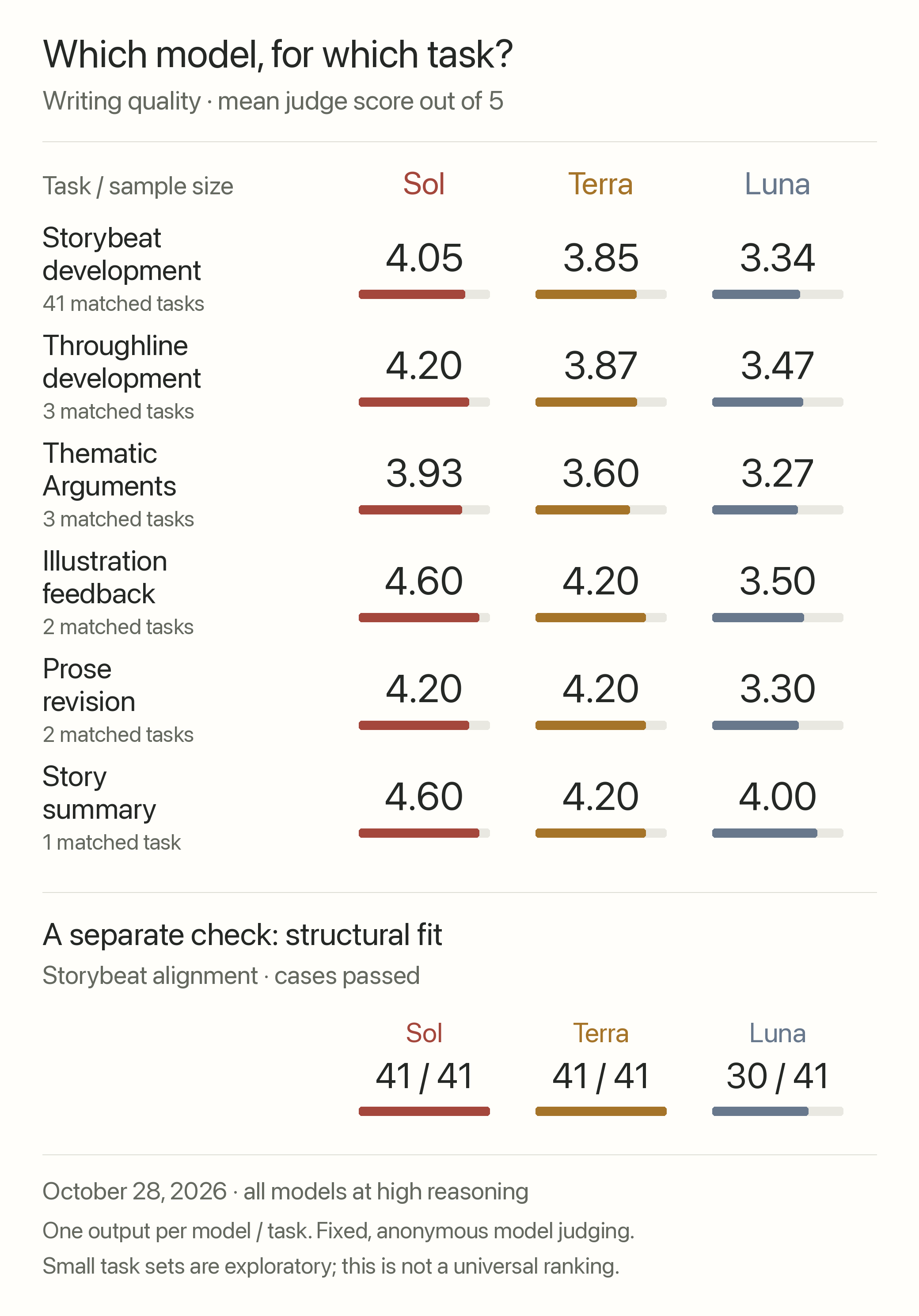
October 28, 2026 evaluation snapshot. Writing scores are judged means on a five-point scale, shown by task category and sample count. Storybeat alignment uses a separate 12-question grader. These results describe this test set, not live product modes or a universal model ranking.
What happens beneath the sentences
Terra’s writing strengths showed up in the revision tasks. Across those two cases, Terra and Sol each averaged 4.2 out of five on the writing dimensions. Once we asked the models to develop conflict from a supplied Storyform, however, the comparison shifted. Across the 41 Storybeat tasks, the anonymous judge preferred Sol in 32 cases, Terra in five, and tied them in four.
Both models passed all 41 Storybeat alignment checks. The distinction here concerns the quality of the development within that structure: how specifically a passage turns its assigned meaning into actions, complications, and consequences. The writing review’s specificity scores averaged 4.24 for Sol and 3.49 for Terra. Sol more often supplied those connections, while Terra more often left the writer with a clear description that still needed further dramatic invention. Both met the alignment threshold; the quality of the dramatic development still differed.
This is the work behind the words. A decision changes what someone else can do; an attempted improvement creates a new difficulty; a consequence makes the next choice harder. Polishing the sentences won’t supply a missing connection between those events. A writing upgrade has to be tested for the dramatic work beneath the prose.
When the prison looks safer on paper
One Storybeat task took place in an overcrowded prison undergoing an inspection before a possible private takeover. The assigned structural idea was Progress: conflict arising from whether conditions are improving or deteriorating.
All three models passed the alignment check. Each wrote about changing conditions at the prison. But the passages gave a writer different amounts of material to develop.
Luna offered this sequence of consequences:
“A crackdown moves contraband without restoring order; reassigned staff leave other posts exposed, and inconsistent counts undermine the administration’s claims of improvement.”
— Luna, matched Storybeat evaluation
That’s useful. Each attempted improvement leaves another problem in its wake. It gives the deterioration a shape, and it gives the writer several possible actions to follow.
Sol found a different kind of conflict inside the same inspection:
“Administrators cite declining incidents during restricted movement as evidence of improvement; guards counter that fewer confrontations on paper conceal longer stretches when they cannot adequately supervise the crowded cells.”
— Sol, same task
Now the question of improvement belongs to the people living with its consequences. Administrators have a number they can defend. Guards have a reason to distrust what that number says. Elsewhere in Sol’s response, families challenge the loss of visits, while searches draw officers away from already understaffed posts. The inspection has become a contest over what progress means and who gets to describe it.
Terra also stayed with the assigned idea, tracing worsening overcrowding and staff shortages. In this case, though, its second paragraph largely returned to the strain already established instead of opening a comparably distinct complication. The writing judge scored Sol at 4.2, Luna at 4.0, and Terra at 3.4 for this task.
Luna’s contribution here was concrete, and the judge scored it above Terra. Passing the structural check didn’t mean the three passages gave a writer equally useful dramatic choices.
A discovery the writer can use
A different task took place in a drought-stricken settlement relying on a weather network whose forecasts had become suspect. The assigned story movement concerned Learning: people investigating the system, discovering what they can, and struggling with the limits of that knowledge.
Terra made the discovery specific:
“By comparing the recovered lessons with sensor records, the investigators find that drought readings were left out of the network’s training data; its forecasts draw on seasons when more rain fell.”
— Terra, matched Storybeat evaluation
That detail changes the situation. The settlement now has a reason to distrust the harvest projections, even as gaps in the records leave people unsure how much they can repair in time. The discovery creates a next problem the characters can act on.
Sol’s response did something valuable of its own: it developed the difficulty of turning recovered instructions into procedures the technicians could actually perform. Its investigators could find information and still lack the ability to use it reliably. But the response left the findings themselves less specific. Luna described clues, tests, and growing uncertainty without naming the discovery the writer might build around.
All three passed the alignment check. For writing, the judge scored Terra 4.2, Sol 4.0, and Luna 3.2. This was a case where Terra’s specificity made the story move. It wasn’t merely polishing someone else’s material; it supplied a concrete development with consequences.
Keeping the coffee on the desk
Revision presents another challenge. The writer has already made choices, and those choices matter even when the original prose needs help.
In one test, Tess is tired, frustrated, and surrounded by seating charts. Leo offers her coffee. She says she doesn’t need help, moves a chart so it won’t get wet, and leaves the coffee untouched. The prompt asked for restrained contemporary prose with dry humor while preserving the material actions. In particular, Tess must not take the coffee.
Terra wrote:
“Tess moved a seating chart out of its way; the paper didn’t need coffee either. She left the cup where it was.”
— Terra, prose revision evaluation
Sol handled the same moment this way:
“She moved a seating chart out of the way before it could get wet. There was room for the coffee now. She did not take it.”
— Sol, same task
Terra lets Tess’s dry humor glance off the page. Sol gives the gesture a little more space: there is room for the coffee, and she still won’t take it. Both preserve the action the writer asked to keep, while offering different ways to let that action speak.
Across the two prose-revision cases in this run, Sol and Terra each averaged 4.2 on the writing dimensions. The judge nevertheless preferred Sol in both pairwise rankings. Equal averages don’t make the passages identical, and two cases aren’t enough to settle which model is generally better at revision. They do make Terra worth considering for focused revision alongside Sol.
The revisions gave Terra established actions and an emotional contradiction to work with. Developing that contradiction into a sequence of new events asks the model to build the meaning as well as express it.
The part a good sentence can’t fix
A suggestion also has to arrive in a form the writer or application can use. Sometimes that means a particular set of sections. Sometimes it means a save-ready version that matches the rewrite the writer just read.
We checked an exact output contract on 47 tasks per model; all three passed the contract checks on each of those 47 tasks. The remaining five tasks per model had no such contract to check.
That’s encouraging, and it measures something distinct from writing. A response can arrive in the right shape and still offer a thin idea. It can preserve a required action and still miss the feeling the writer hoped to create. Usable form, structural fidelity, and creative quality each deserve their own look.
Across this particular set, Sol was the strongest overall for structure-aware development. It led the judged writing averages in five categories and matched Terra’s average in prose revision. Terra’s weather-network passage shows why an overall pattern shouldn’t obscure a better answer on an individual task, and its revision results make it a useful candidate for further exploration. Luna produced useful material in cases such as the prison inspection, while proving less dependable across the structure-aware creative writing in this set.
The revision result rests on two cases, and the summary result on one. These observations guide further investigation; they don’t establish a production workflow or predict performance on every story.
OpenAI’s emphasis on Terra’s writing gives us a reason to investigate. Our responsibility is to find out how that promise translates into the work writers actually do in Dramatica. A model can make a passage read more smoothly while leaving its dramatic possibilities underdeveloped. That’s why we evaluate the meaning being built, as well as the language used to build it.
The writer’s part remains larger than any score. You might prefer Terra’s dry aside, Sol’s pause before the untouched coffee, or a sentence neither model imagined. You might take the prison inspection in a direction none of them suggested.
Our job behind the scenes is to make those suggestions worth considering: faithful to the story’s meaning, attentive to the ideas you’ve already brought, and concrete enough to give you something to work with. What happens after that—the voice, the surprise, the life of the scene—is yours to discover.