My Cousin Vinny: Three Storyforms and the Question of Help
Does My Cousin Vinny turn on getting the facts right or accepting help? We compare the competing interpretations across all Four Throughlines, examine every Signpost, and explain the narrow case for Control/Uncontrolled.
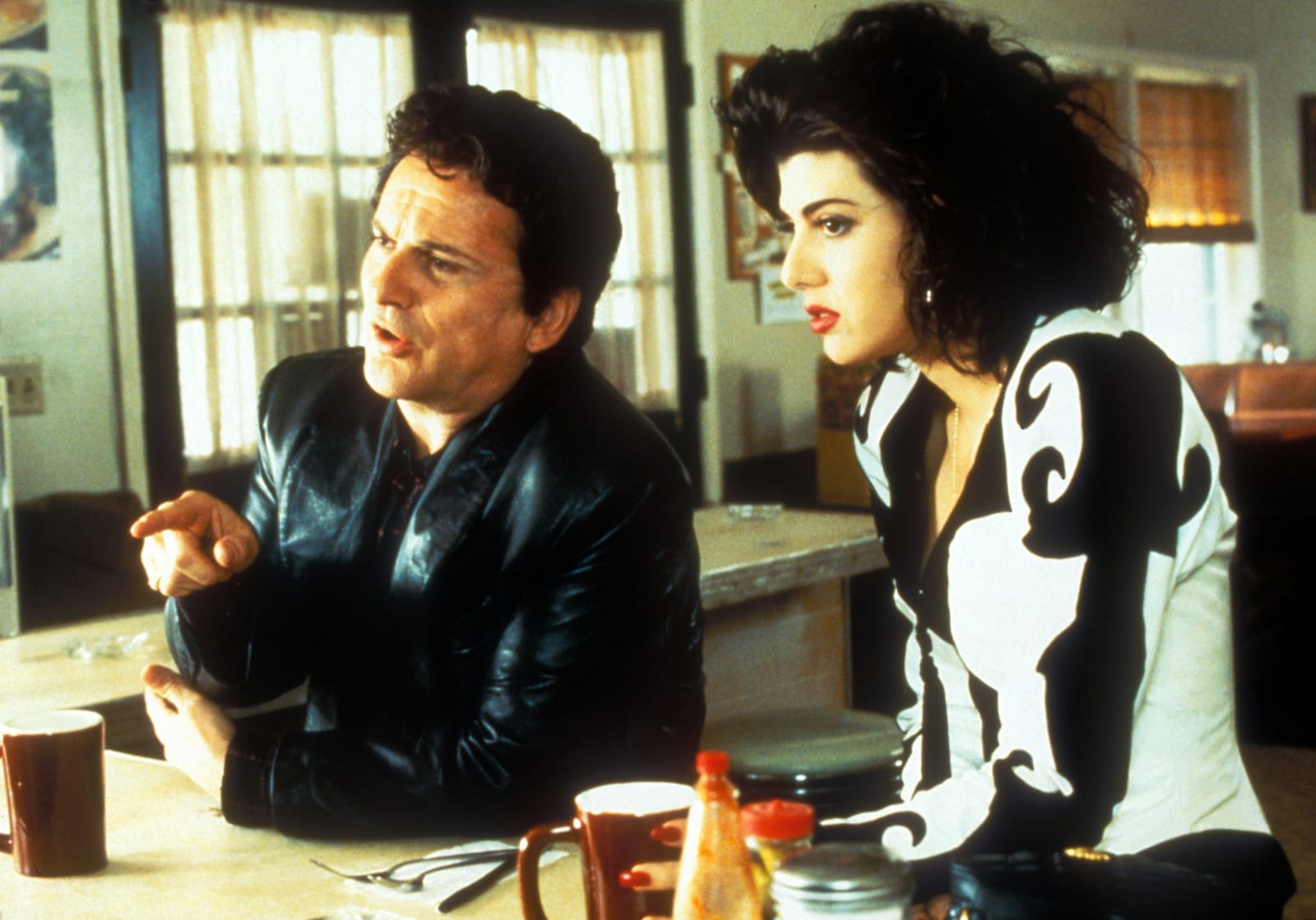
Full-film spoilers for My Cousin Vinny (1992).
Vinny Gambini can spot the hole in somebody else’s argument almost immediately. He has a harder time seeing what’s wrong with his own idea of success. By the end of My Cousin Vinny, those two abilities have become entangled: the woman he keeps shutting out supplies the expertise that lets him win his first case.
That leaves an unusually good question for anyone trying to understand how a story works. The defense needs both a precise identification and Vinny’s willingness to accept help. Which difficulty does the film keep returning to as the source of its conflict, and which change explains the resolution most fully?
Both descriptions find substantial evidence in the film. Accuracy explains some of the finest courtroom comedy ever written; accepting help reaches into Vinny’s professional ambition, his defensiveness, and the engagement that has been waiting for that ambition to deliver. Deciding between them requires more than choosing the description we like best.
The Dramatica Users Group wrestled with that question on September 8, 2020, and the session ended with Chris Huntley selecting Control/Uncontrolled. It also ended with real objections, including a third proposal whose complete structure was never presented. Years later, revisiting the recording meant revisiting the disagreement as well as the answer.
Chris’s version remains the narrow favorite because it connects Vinny’s idea of achievement to the partnership he keeps postponing. The courtroom evidence gives the accuracy alternative a formidable claim, and Brian’s unfinished proposal opens another question about Vinny’s professional identity. To choose among them, we have to follow the whole argument—from the grits and tire tracks to the marriage that’s still waiting for his first victory.
Returning to the movie after a disputed analysis
The original request came from a recollection of the disagreement. Jim Hull remembered favoring an Accurate/Non-Accurate direction and siding with Brian while Chris led the group toward something else. The first useful discovery was that the recollection joined together two positions that the recording keeps separate.
Brian explicitly says near the end that his proposed Storyform wasn’t the Non-Accurate/Accurate one. He had a different version, with Vinny as a Be-er, and wanted the group to examine it. Jim, meanwhile, contributes to the explanation of Chris’s model during the session, including the suggestion that putting Mona Lisa on the stand and allowing her contribution to unfold illustrates Uncontrolled.
That history deserves more care than a simple account of Jim and Brian opposing Chris. People can find one model persuasive in some respects, recognize an illustration in another, and still object to how the group reaches its conclusion. Changing one’s mind about an illustration isn’t the same as endorsing every dependent selection.
The session also contains a genuine disagreement about process. Chris explains that he and Jim had discussed the movie beforehand, partly to avoid the long circular searches that had characterized other meetings. Brian objects that the group hasn’t been able to inspect the reasoning behind the preferred answer in the usual way; other participants recognize the value of seeing more of that process.
Chris acknowledges exercising facilitator authority and invites reconsideration afterward. He also rejects the idea that his experience or role in developing Dramatica should be sufficient reason to accept a result. Those two facts belong together: he made the selection, and the selection remained open to challenge. September 2020 recording.
There was another concern in the room. Several analyses had recently landed in the Proven/Unproven/Accurate/Non-Accurate area, and Chris wondered whether the group had developed a habit of seeing that structure everywhere. The counterargument was that the films themselves had been selected by people with overlapping tastes, so recurring patterns might reflect the selection of movies rather than a mistaken reading of them.
Either possibility is worth examining. Neither determines the structure of My Cousin Vinny. An analyst’s familiarity with a particular group of concepts can create a blind spot, but frequency alone can’t disprove the next example; the film still has to supply the deciding evidence.
The later investigation set aside the question of who had prevailed in the room and compared the models against the same scenes across the whole film. Its sources were the complete original-audio discussion transcript, a detailed synopsis, an available screenplay draft, current structural data, and public forum discussion. No fresh full-film viewing was undertaken, so performance, tone, and exact act boundaries remain less securely assessed than the recorded selections and arguments. Where those sources leave an illustration incomplete, the possible readings developed below remain proposals to test, distinct from the participants’ documented selections.
Four questions hiding inside one courtroom comedy
From a distance, this is a story about two innocent young men facing a murder prosecution. From Vinny’s position, it’s also about proving that he can do the job. Mona Lisa challenges what proving himself is allowed to mean, while their relationship has its own unfinished business: whether the life they keep promising each other will ever arrive.
Dramatica calls these four sustained viewpoints the Four Throughlines. The Objective Story looks at the shared conflict in which the ensemble participates. The Main Character follows the personal difficulty we experience from inside one person’s life; the Influence Character presents the alternative outlook that challenges that person; the Relationship Story follows what happens between them as a relationship.
Vinny is the Main Character in these candidates, and Mona Lisa is the Influence Character. That doesn’t make every scene involving either character part of their personal Throughline. When she explains the tire tracks, she contributes to the Objective Story; when her insistence on partnership challenges Vinny’s solitary conception of achievement, the same character is doing different dramatic work.
The distinction also explains why spending time with Bill and Stan doesn’t automatically transfer the Main Character position to them. Their fear, their choice of counsel, and their reactions to the trial remain directly involved in the shared prosecution. The recording doesn’t establish a separate sustained personal inequity for either young man comparable to Vinny’s difficulty with himself.
Judge Haller presents a similar temptation. He challenges Vinny constantly, but much of that challenge concerns the legitimacy and conduct of the defense attorney in the case. Satisfying the judge’s demand for acceptable credentials can resolve a practical obstacle without establishing a fundamental change in the judge’s outlook or making him the principal Influence Character.
A Storyform describes the structural argument connecting these viewpoints. The events, dialogue, performances, and jokes are the Storytelling that gives that argument expression. A computer can establish that a set of structural selections belongs together; it can’t establish that a particular film expresses them convincingly.
Within each Throughline, a Domain names the broad kind of conflict: an external Situation, an Activity, an internal way of thinking, or a fixed attitude. A Concern narrows that area to something sustained, such as Obtaining a result or Becoming something different. An Issue identifies a thematic value being explored, and a Problem/Solution pair identifies the source of the difficulty and the element that would resolve it.
Those levels matter here because a film can contain prejudice without making entrenched attitudes its broadest shared conflict. It can contain facts without making Fact its thematic Issue. The work is to show where an idea generates conflict, at what level, and from whose viewpoint.
The two complete candidates we actually compared
The main comparison involved two structurally compatible models. They share the same broad allocation of Domains and the same eight Dynamics, the settings that describe the character’s development and the story’s overall movement and resolution. Their differences extend well beyond replacing one word in the courtroom explanation.
Chris’s selected model has the following structure. The current matrix reference is 9987; that reference identifies a combination in the structural library, rather than a measure of how well it fits this film.
| Throughline | Domain | Concern | Issue | Problem → Solution |
|---|---|---|---|---|
| Objective Story | Universe: a Situation | Future | Preconception | Control → Uncontrolled |
| Main Character | Physics: Activity | Obtaining | Self Interest | Control → Uncontrolled |
| Influence Character | Psychology: ways of thinking | Becoming | Commitment | Logic → Feeling |
| Relationship Story | Mind: a fixed attitude | Subconscious | Denial | Conscience → Temptation |
The Non-Accurate/Accurate alternative, current matrix 20647, keeps those Domains but changes the sustained Concerns, thematic Issues, and underlying Problems. Here Non-Accurate refers to operating outside an acceptable range or tolerance; Accurate refers to coming within it. This is more precise than a general distinction between falsehood and truth.
| Throughline | Domain | Concern | Issue | Problem → Solution |
|---|---|---|---|---|
| Objective Story | Universe | Progress | Fact | Non-Accurate → Accurate |
| Main Character | Physics | Doing | Experience | Non-Accurate → Accurate |
| Influence Character | Psychology | Being | Desire | Process → Result |
| Relationship Story | Mind | Preconscious | Value | Cause → Effect |
The Influence Character and Relationship Story have their own pairs in both models. Describing all four as Control/Uncontrolled, or all four as Non-Accurate/Accurate, would erase the very differences the comparison needs to examine. Mona Lisa’s Logic/Feeling and the relationship’s Conscience/Temptation therefore need evidence in their own right.
Both models resolve to complete current combinations. That makes them legitimate candidates for comparison and prevents us from combining the strongest selections from each into a third model without checking what that combination implies. Structural compatibility gives us a coherent proposition to test; the proposition still has to survive contact with the movie.
The eight Dynamics, and the reasons behind them
The shared Dynamics are Change, Stop, Do-er, Linear, Decision, Optionlock, Success, and Judgment Good. Their shared status helps keep the first comparison controlled. It also shows that agreement on a character’s broad arc can coexist with substantial disagreement about the source of that arc.
| Dynamic | Selection | Working interpretation |
|---|---|---|
| Main Character Resolve | Change | Vinny moves from refusing assistance to relying on it. |
| Main Character Growth | Stop | Repeated obstructive behavior has to cease for his Change to occur. |
| Main Character Approach | Do-er | His recurring preference is to change his external circumstances. |
| Problem-Solving Style | Linear | He proceeds through causal steps, tests, and counterarguments. |
| Story Driver | Decision | Major deliberations and choices organize the shared story’s turns. |
| Story Limit | Optionlock | Available legal avenues and stages become exhausted. |
| Story Outcome | Success | The prosecution ends and the boys’ threatened future is released from the case. |
| Story Judgment | Good | Vinny’s personal difficulty is read as resolved, despite continuing banter. |
The proposed Change is easy to see in Vinny’s conduct. Early on, he excludes help and even interferes with Mona Lisa’s efforts to understand the procedure; later, he needs her contribution enough to bring her into court. What that act means to him is harder to establish. Both candidates read it as a deeper Change—relinquishing exclusive Control or correcting an inadequate assessment of himself and her—while his final complaint about needing help leaves room for the Judgment dispute we’ll return to.
Stop describes the direction of Growth, which is related to that Change but distinct from it. The strongest session examples concern behavior that repeatedly gets him held in contempt and jailed: he continues speaking or behaving improperly after being told to stop. By the later courtroom confrontation over expert evidence, he can make his objection and accept the ruling without repeating the earlier response.
This is more useful than saying he must stop refusing help so that he can start accepting it. That formulation simply describes the same transition twice and leaves the Growth question unanswered. The recurring behavior and its consequences give the Stop reading something concrete to explain.
Vinny’s failed attempts to sleep give the Do-er reading its clearest recurring example. He changes locations to find surroundings he can tolerate, rather than repeatedly changing himself to fit the surroundings. Even the joke about preferring jail for sleep belongs to that pattern, though a convenient place to sleep doesn’t undo the conduct that landed him there. This shows an external preference for handling that particular personal difficulty; we still have to connect it to his central conflict about achievement.
His handling of the unpaid money offers another example. When Mona Lisa has been stiffed, Vinny goes to confront the man, negotiates the conditions of a possible fight, and demands that the promised money actually be shown. The session treats his choice to change the external circumstances as evidence of Do-er. Its force comes from the way he attempts to resolve the difficulty, not from how loudly he speaks or how many physical actions the scene contains.
That distinction becomes essential when considering Brian’s Be-er proposal. A Be-er preferentially tries to accommodate a personal inequity internally, through a change in self, outlook, or manner of thinking. Assertiveness is a separate quality: an assertive Be-er is possible, as Chris explicitly explained in a 2018 forum discussion. Chris on Approach.
Linear describes the way Vinny works through problems. The rolled money, the successive negotiating steps, and the witness examinations all proceed by identifying a claim, testing a condition, and pursuing the consequence. His lack of courtroom experience doesn’t make that thinking absent; much of the comedy comes from applying an existing argumentative ability in unfamiliar circumstances.
Decision as Driver was more contested. The killing and arrest look like obvious actions that set everything in motion, and the judge’s final acceptance of Vinny’s credentials was proposed as another action-based ending. The selected reading treats the crime and arrest as setup for the deliberation that brings in Vinny, and the prosecutor’s dismissal as the close of the Objective Story. That boundary has to hold across the film’s causal pattern; calling the opening actions setup can’t simply remove inconvenient evidence for Action.
At the midpoint, the group identified the decision to retain Vinny after his playing-card demonstration as a strong turn. The apparent solidity of the prosecution’s case becomes something that can be examined from another angle, and choosing this lawyer changes what follows. This is a claim about causal organization across the story, rather than a claim that no significant action occurs.
The later act turn was less secure. The discussion moved among the judge’s refusal of Vinny’s argument, Mona Lisa’s decision to leave, and Vinny’s reconsideration of the photographs. Those moments are closely related, and the recording leaves their precise structural boundary unsettled.
Optionlock means the climax arrives as possibilities run out, rather than when a specified amount of time expires. The available counsel, the evidence, the witnesses, and the successive stages of the trial make a bounded field of action. The judge repeatedly tells Vinny what belongs in the current procedural stage, making those limits visible to the audience.
Even here, the illustration needs qualification. Evidence is revisited, and the group debated whether the options were pieces of evidence, each side’s examination of them, or the trial’s stages. The bounded scope is persuasive; an exact inventory in which each witness equals one irrevocably exhausted option is less secure.
Success concerns the shared problem being resolved. In the selected model, it requires the Objective Story Solution to come into play effectively; simply showing happy faces or a release from jail doesn’t demonstrate how that happens. Judgment Good concerns Vinny’s personal resolution, so it needs a separate argument from the fact that the defense wins.
Why accuracy makes such a strong courtroom argument
The Non-Accurate/Accurate case begins with a recurring mechanism. People accept an account because the visible details appear close enough, then Vinny shows that those details don’t satisfy the conditions required by the conclusion. The conflict repeatedly turns on the difference between a plausible correspondence and a physically sustainable identification.
The grits testimony is a particularly clear illustration. A witness’s estimate of elapsed time depends on a cooking process that can’t fit the stated interval. Vinny’s questions expose a tolerance problem: the story the witness tells and the time that process requires won’t coexist within the same account.
Eyesight and distance supply another version. A witness’s confidence has to be tested against the actual conditions under which the identification was made. The issue becomes the ability to distinguish the defendants at that distance, rather than the sincerity with which a witness insists on having seen them.
The confused confession adds a different mismatch. Bill believes he is acknowledging an unpaid item while the authorities understand him to be answering a murder accusation. Speech that sounds decisive acquires its apparent force from incompatible assumptions about the question being asked.
The similar cars bring these ideas together. Two young men, a vehicle that looks right, compatible timing, and apparently corresponding tires make the accusation initially plausible. The later analysis of the tracks introduces a distinction that the resemblance has concealed.
Mona Lisa identifies the mechanical conditions needed to produce those marks, and the prosecution’s expert accepts the correction. The Pontiac Tempest and the Buick Skylark can be close enough to confuse observers while differing in the features that matter to the tire evidence. The sheriff’s discovery of other suspects connected with the appropriate car and a matching type of weapon supplies a concrete alternative to the original identification. AFI’s synopsis corroborates that chain of events.
That last distinction matters. The actual-perpetrator discovery, the expert’s willingness to acknowledge the vehicle distinction, and the prosecutor’s dismissal show evidence changing the legal position. They weaken a reading built around uniform hostility to outsiders. They don’t, by themselves, rule out an Objective Story in Mind: a fixed attitude can concern guilt or credibility without becoming an ideology, and its eventual revision could be the resolution such a model predicts.
This is why the accuracy candidate deserves more than the observation that courtroom stories contain facts. It identifies a repeated source of trouble and a repeated method of resolving it. The case becomes most persuasive when Non-Accurate means treating an insufficient match as sufficient and Accurate means identifying the distinctions the conclusion must actually satisfy.
It also identifies the largest weakness in the selected Control model’s Objective Story explanation. Saying the boys are controlled in jail and then become free describes their condition before and after the resolution. It doesn’t, on its own, explain the causal Solution that makes that change possible.
The accuracy interpretation explains the courtroom’s immediate mechanism exceptionally well. It still needs a convincing account of Progress as Goal and of the other Throughlines, each with its own selections. The same standard applies to Control: a compelling personal arc can strengthen that candidate, but cannot substitute for showing what Control causes in the shared prosecution.
A threatened Future and the cost of excluding help
Chris’s Objective Story reading begins with a Situation: two innocent young men have been accused of murder, confined, and placed on a course that may destroy their lives. Their predicament remains a problem even if everyone in the town becomes friendlier. A fairer attitude alone won’t identify the other car or end the prosecution.
Future is the sustained Concern and the Story Goal in this model. The trial determines what will happen to two people at the beginning of their adult lives, giving the effort to protect their future an immediate emotional basis. That makes Future a persuasive candidate, though threatened lives can also express the stakes of pursuing a different Goal. Brian’s later objection bears directly on this distinction.
Progress, the alternative Goal, has real material to work with. Bill and Stan’s reactions register the defense getting worse and then improving, and Vinny’s performance visibly changes the course of proceedings. The strongest possible reading would make the shared effort an attempt to reverse a prosecution advancing toward conviction: each apparently sufficient match carries it forward until a physical distinction stops that advance. This formulation develops the alternative beyond what the recording establishes; it remains a hypothesis to test, rather than a recovered explanation from a participant.
Does reversing that advance organize what the ensemble is trying to resolve, or does it chiefly measure the effort to secure the boys’ future? A trial passing through stages is insufficient proof of Progress, just as threatened lives are insufficient proof of Future merely because the stakes matter. Future remains the preferred reading, with both candidates carrying the same burden of showing what the shared effort is actually about.
Preconception gives Chris’s candidate a thematic explanation for material that initially suggested Mind as the Domain. People bring assumptions about unfamiliar defendants, a proper attorney, a woman’s usefulness, local customs, and what an observation must mean. Those expectations color the conflict without necessarily establishing fixed attitudes as its broadest source.
The recording’s examples range from the judge’s expectations to Vinny’s idea of how people dress, and from Stan’s fears about jail to misunderstandings during the first meeting with counsel. Their range supports Preconception as a recurring thematic lens. It doesn’t require all the participants to share the same prejudice or remain impervious to contrary information.
Help and Hinder supply the selected model’s Symptom and Response. A Symptom is where people direct their attention when trying to understand the trouble; a Response is how they react to what they think they see. Here offers of help can produce obstruction, and efforts to stop obstruction can themselves obstruct the defense.
The boys ask for help and receive an attorney who doesn’t know courtroom procedure. Witnesses try to help establish what happened, and their imperfect observations make the accusation more difficult to escape. The judge gives Vinny procedural guidance while also restricting conduct that interferes with the trial; Vinny treats Mona Lisa’s assistance as an intrusion on what he wants to accomplish himself.
Help/Hinder recurs in the Objective Story, Influence Character, and Relationship Story in the selected structure. That repeated placement was a major reason Chris found the model persuasive, while the Main Character retains the more specific Pursuit/Avoid pair. It gives the recurring assistance a place in the structure. But those placements identify Symptom and Response; we still have to show how the trouble people see and the remedies they attempt arise from Control as the underlying Problem.
The stronger Control/Uncontrolled argument concerns what Vinny permits to happen. His insistence on managing the achievement excludes a contribution the case needs. The session includes Jim explicitly offering her eventual freedom to testify as a causal illustration of Uncontrolled, beyond the boys’ release. On this reading, allowing knowledge he cannot supply himself to face scrutiny removes an obstruction he has helped sustain.
Vinny still manages that testimony strategically. He brings a reluctant Mona Lisa into court and treats her as a hostile witness, as the recording itself discusses. His willingness to use her expertise hardly means he stops controlling events. The proposed shift is more specific: he gives up exclusive ownership of the expertise and lets her command of the subject carry an exchange he could not carry alone.
That can explain his personal movement, but its extension to the Objective Story remains the selected model’s hardest task. Vinny’s exclusion of help did not create the mistaken accusation, and relaxing that exclusion would not free the boys without the vehicle distinction. Accurate knowledge, in turn, cannot help the defense while it is kept outside the case. The ending needs both changes; establishing that each is necessary still leaves us asking which candidate names the deeper shared Problem.
This leaves a real interpretive choice. We can see the corrected vehicle identification as the deeper Solution, with accepting help as the route to it. Or we can see Vinny’s release of exclusive Control as the broader resolution, expressed through a precise identification that his earlier conduct had kept from becoming useful.
The whole-film comparison modestly favors the latter. That judgment depends on what the other Throughlines add, and it loses force if their dependent Storypoints can’t be illustrated. It also leaves the accuracy evidence fully intact as the strongest challenge to the adopted interpretation.
Vinny already has Skill
The Main Character comparison becomes clearer once we stop treating Vinny as a man with no relevant ability. He is unfamiliar with procedure, but he can spot a trick, interrogate a claim, negotiate, and expose a witness’s weakness. The group explicitly corrects an objection that the accuracy model’s Unique Ability of Skill can’t fit him.
A Unique Ability describes the distinctive capacity through which a character can contribute to the resolution. Skill is therefore a serious point in the alternative’s favor. Experience/Skill captures the difference between knowing how this court works and already having the ability to dismantle a bad argument.
Doing as his Concern also has obvious support. Much of his difficulty involves carrying out the job: speaking at the right time, questioning witnesses, complying with requirements, and actually functioning as counsel. A Non-Accurate personal Problem could describe his working beyond tolerances his current experience allows, then developing a more accurate assessment of his abilities and Mona Lisa’s.
The selected model locates the personal conflict more specifically in Obtaining his first victory and the Self Interest bound up in obtaining it himself. The legal achievement has become a test of personal worth on terms that exclude dependence. He doesn’t simply need enough information to perform competently; he needs to let the achievement mean something other than proof that he required nobody.
That reading explains why help bothers him even when it’s useful. Mona Lisa’s knowledge threatens the ownership of the success he wants. His instinct to take the book away from her makes sense as an effort to retain Control of the endeavor, even while it undermines his chance of accomplishing it.
His eventual use of her expertise can support either candidate at first glance. Under Non-Accurate/Accurate, he finally assesses her contribution adequately. Under Control/Uncontrolled, he allows her to contribute despite what receiving help has meant to his image of the victory.
Control draws support from how often the possibility of assistance itself troubles him, and from the final conversation’s return to winning without it. The accuracy reading can also explain a persistent difficulty. Vinny could repeatedly insist that his own contribution is sufficient, despite recurring evidence that it falls outside what this job requires; accepting Mona Lisa’s contribution would bring his working assessment within those demands.
That gives the alternative more to say than simply that he learns she is competent. His Skill can be real while his estimate of what it can accomplish unaided remains inadequate. Control still connects more directly to his concern with owning the victory, but persistence alone can’t distinguish exclusive Control from a repeatedly inadequate assessment. What matters is why useful help troubles him.
The selected model’s Pursuit/Avoid Symptom/Response also has a recognizable starting point. He keeps pushing, or responds to being pushed by trying to prevent what he doesn’t want; the session uses his badgering and negotiations to discuss Approach as his Unique Ability. Those are useful illustrations, though the word “approach” in that Storypoint has a different function from the Do-er/Be-er Dynamic.
Understanding serves as his Benchmark, a measure by which the development can be tracked. His increasing grasp of courtroom demands gives us evidence of movement without turning ignorance into the sole underlying personal Problem. Learning procedure remains necessary even when the more consequential Change concerns accepting another person’s contribution.
The distinction keeps both readings honest. The accuracy model can’t be dismissed on the grounds that he has no Skill, and the Control model can’t pretend procedure is irrelevant. The question is which structure better explains why his problems take the particular personal form they do.
Mona Lisa’s influence extends beyond the witness stand
Mona Lisa’s expertise is indispensable to the prosecution’s collapse. Her Influence Character Throughline asks a different question: what alternative way of looking at life does she keep putting before Vinny? If we answer only that she knows cars, we’ve explained her usefulness and left her influence largely unexamined.
Becoming and Commitment have strong material in the delayed marriage and family. She is concerned with a shared life that has been postponed while Vinny tries to become established, and she challenges the assumption that their partnership must wait outside his professional self-definition. What they are becoming together can’t remain indefinitely suspended by the conditions he has attached to proving himself.
In the alternative, Being and Desire describe her wish to occupy a more meaningful role. She could be understood as refusing to remain an accompanying fiancée and insisting on being recognized as an intellectual and professional partner. That is a credible reading, especially when her contribution is repeatedly dismissed.
Several participants question whether she is trying to prove her worth or already understands it and is waiting for Vinny to make room for her. That objection usefully resists turning her into a woman whose worth depends on his approval. It is less effective as an objection to Being itself: she can know exactly what she is worth and still challenge the role she is expected to play.
Being/Desire is strongest in the gap between the partner she wants to be allowed to act as and the accompanying role Vinny keeps assigning her. Knowing her own abilities could make that challenge stronger: she understands what he is excluding. Becoming/Commitment remains persuasive because marriage and family involve a lasting change in their lives, while her confidence in her worth leaves the alternative fully available.
The accuracy candidate assigns her Ability as Unique Ability, Experience as Critical Flaw, and Becoming as Benchmark. A Critical Flaw is the characteristic that can undermine her effectiveness, while a Benchmark measures movement through her Concern. Her lack of law-school experience can be used against her, but her demonstrated knowledge makes it hazardous to explain the entire influence as a struggle to prove she is sufficiently qualified.
The selected model gives her Rationalization as Unique Ability and Attitude as Critical Flaw, with Conceptualizing as Benchmark. Chris’s explanation of Rationalization focuses on her ability to recognize and challenge Vinny’s excuses; the Attitude illustration concerns exchanges in which her manner makes it easier for him to shut out the point she is making. These are the session’s proposed encodings, rather than proof that every use of those terms has been exhaustively demonstrated.
The lower-level Problem/Solution comparison remains weaker. Logic/Feeling in the adopted model needs more than the claim that she is emotional and he is logical. Her mechanical knowledge doesn’t prove Logic, and her frustration doesn’t automatically prove Feeling resolving it.
Process/Result in the alternative needs similar care. Testifying effectively and producing a result in court don’t, on their own, demonstrate the source and resolution of her challenge to Vinny. One possibility is that she challenges a process that indefinitely postpones their shared life until it yields a result they can live with. That gives us a more specific hypothesis to test, though the available research doesn’t establish the required sequence of conflict and resolution.
The evidence for Becoming/Commitment remains stronger than the evidence establishing every dependent element beneath it. This limits the weight the Influence Character comparison can carry: its provisional Concern preference cannot be counted as a separate demonstration of Logic/Feeling. Nor can the same marriage material become independent proof every time it is described from a different Throughline; each viewpoint has to contribute something distinct.
The relationship can change while the bickering continues
Vinny and Mona Lisa are still going to argue. Their verbal combat is part of how they enjoy each other, as well as a way they hurt and obstruct each other. An analysis that treats the disappearance of argumentative behavior as the relationship’s resolution will have trouble with the ending.
The Preconscious Concern in the accuracy candidate focuses on immediate reactions: the quick retort, the defensive response, the reflexive refusal. Value explores how each regards the other and what the relationship regards as worthwhile. Cause/Effect would then have to explain the specific relationship difficulty and its resolution, rather than simply identify that their exchanges have consequences.
That structure finds real material. The rapid exchanges continue after the victory, so their mere presence cannot reveal what has changed between the two people. But their continuation also cannot disprove Preconscious: a Concern identifies an area of conflict, and the model does not require every quick response to disappear. The more useful question is whether their reflexive reactions still deny each other value in the same damaging way.
The strongest alternative would distinguish a defensive exchange that excludes a partner from affectionate sparring that permits partnership. Value can concern the place each gives the other within the relationship without requiring Mona Lisa to lack self-worth. That is a possible explanation of the relationship’s movement; Cause/Effect still needs its own illustration. The desires, hurts, and attachment beneath those exchanges remain more persuasive, but the case against Preconscious has to rest on more than the fact that the couple keeps talking back.
Subconscious in the selected model concerns those basic drives and longings. They want one another and want a shared life, but the condition attached to marrying has kept that desire from taking shape. Denial describes the refusal of participation and recognition that makes the engagement feel stalled even while affection remains present.
The selected Relationship Story Catalyst is Closure, while its Inhibitor is Preconception. A Catalyst accelerates the conflict’s development; an Inhibitor slows it. Bringing the engagement toward resolution can move them forward, while assumptions about how help, competence, and partnership must work keep blocking cooperation.
The alternative gives Confidence and Threat those accelerating and delaying roles. Confidence has an intelligible connection to their exchanges, but Threat needs more exact relationship evidence. During the session, the Closure/Preconception pair was judged more persuasive, though the suggestion that Vinny simply sees Mona Lisa as an incapable beautician also met resistance.
That objection deserves to remain. If Vinny already knows she is capable in other settings, his exclusion of her may reflect his need to own this particular accomplishment more than a general belief that she is unintelligent. The Control interpretation is strengthened by making that distinction, rather than by inventing a condescension broader than the film supports.
Conscience/Temptation is the adopted relationship’s Problem/Solution pair. The recording proposes the tension between what they know they should do about their promises and what they actually allow themselves to pursue. That gives the pair a starting point, while its precise resolution remains insufficiently illustrated.
Temptation shouldn’t become a convenient synonym for getting married, just as Conscience shouldn’t become a general label for feeling responsible. The analysis has to show how those motivations organize the relationship’s conflict. Subconscious/Denial and Closure/Preconception can be persuasive while this deeper assignment remains open to better illustration.
What the remaining plot selections say, and what they don’t prove
A complete model carries further selections beyond its Goal and Problem. Requirements describe what must be achieved for the Goal; Prerequisites and Preconditions describe forms of necessary preparation or imposed conditions. Dividends are benefits that arise during the effort, Costs are what the effort exacts, and Forewarnings indicate the threatened Consequence approaching.
The following values preserve the two complete candidates as tested. The table records structural selections, rather than pretending that every row received the same degree of scene-level examination. The distinction is especially important when a coherent model supplies fields that the discussion has barely illustrated.
| Plot Storypoint | Control/Uncontrolled | Non-Accurate/Accurate |
|---|---|---|
| Goal | Future | Progress |
| Consequence | Subconscious | Preconscious |
| Requirements | Past | Future |
| Prerequisites | Memory | Subconscious |
| Preconditions | Conceptualizing | Becoming |
| Dividends | Obtaining | Doing |
| Costs | Becoming | Being |
| Forewarnings | Understanding | Obtaining |
Past as Requirements has a natural starting point in establishing what actually happened, and the adopted Objective Story Benchmark is also Past. The more the crime’s history can be reconstructed, the more the case approaches a resolution. That overlap supplies an illustration to test, rather than a reason to collapse Requirements, Benchmark, and a Past Signpost into one concept.
Subconscious as Consequence received a less secure explanation in the room: the characters’ greatest fears would come true. The threatened execution plainly supplies stakes, but naming that fear doesn’t automatically demonstrate the complete Consequence across the story. Comedy may draw it lightly; light treatment still needs an intelligible structural illustration.
For the alternative, Future as Benchmark helps explain why concern for the defendants’ prospects remains visible even with Progress as Goal. Its Security/Worry Catalyst/Inhibitor pair also belongs to that complete Objective Story selection, alongside Unproven/Proven as Symptom/Response. Those fields shouldn’t be silently replaced with the selected model’s Openness/Denial and Help/Hinder merely because those have stronger examples.
For completeness, the remaining supporting selections are collected below. In the Objective Story and Relationship Story, the middle pair is Catalyst/Inhibitor; in the two character Throughlines, it is Unique Ability/Critical Flaw. These rows keep the candidates intact, including fields the discussion did not illustrate closely enough to weigh.
| Throughline and candidate | Symptom → Response | Catalyst / Inhibitor or Unique Ability / Critical Flaw | Benchmark |
|---|---|---|---|
| Objective Story: Control | Help → Hinder | Openness / Denial | Past |
| Objective Story: Accuracy | Unproven → Proven | Security / Worry | Future |
| Main Character: Control | Pursuit → Avoid | Approach / Obligation | Understanding |
| Main Character: Accuracy | Determination → Expectation | Skill / Desire | Obtaining |
| Influence Character: Control | Help → Hinder | Rationalization / Attitude | Conceptualizing |
| Influence Character: Accuracy | Unproven → Proven | Ability / Experience | Becoming |
| Relationship Story: Control | Help → Hinder | Closure / Preconception | Memory |
| Relationship Story: Accuracy | Unproven → Proven | Confidence / Threat | Subconscious |
A causal explanation still has to do more than match a label. In particular, Obligation, Determination/Expectation, Desire as Vinny’s Critical Flaw, and the Relationship Story Benchmarks are preserved selections rather than newly demonstrated findings. Canonical selection doesn’t give every row an equal depth of evidence.
Sixteen Signposts, with a surprising limitation
After the whole-film comparison came a more detailed request: examine the four major movements of each Throughline. Dramatica calls those movements Signposts. They describe sustained developments in the conflict, so finding one scene that mentions a concept is weaker evidence than showing an act substantially organized around it.
The current structural data supplied a significant finding. Both main candidates return exactly the same sixteen Signposts, in the same orders. The comparison can therefore test their shared temporal arrangement, but it can’t independently decide between their different Problems.
| Throughline | Signpost 1 | Signpost 2 | Signpost 3 | Signpost 4 |
|---|---|---|---|---|
| Objective Story | Future | Present | Past | Progress |
| Main Character | Understanding | Learning | Doing | Obtaining |
| Influence Character | Conceiving | Being | Becoming | Conceptualizing |
| Relationship Story | Conscious | Preconscious | Subconscious | Memory |
These are the exact current orders for the two compared combinations. They aren’t an assertion that the legacy software visible in the 2020 session used identical ordering. An order difference between current and legacy output is a matter to document and investigate; it doesn’t, by itself, establish an additional Storyform in the film.
The matrix also can’t settle which stretch of the movie expresses which movement. That requires interpretation of the finished work, including uncertainty about the later act turn already discussed. A succession of prosecution witnesses is a succession of witnesses until the causal and thematic development supports a larger structural claim.
The Objective Story’s final Progress remains the difficult placement
Future is a strong opening movement. The accusation threatens to cut off two young men’s expected lives, and the choice of representation matters because of what now awaits them. This is consequential concern for their future, rather than a stray conversation about what happens next.
Present is a plausible second movement. The immediate legal situation becomes untenable: Vinny is inexperienced in court, preliminary proceedings go badly, and the defendants must decide whether to retain him. The circumstances they have to manage now come to the foreground.
Past is exceptionally strong material for the third movement. Cross-examination dismantles the prosecution’s account of what occurred through cooking time, visibility, identification, and the physical evidence. The conflict is specifically about establishing which reconstruction of an earlier event can stand.
Progress is the least secure final placement. The defense’s position improves, the forensic testimony threatens those gains, and the last reversal transforms how the case is going. Those developments give a Progress reading material, but a case improving or deteriorating is common to many courtroom climaxes.
The more specific difficulty is that the climax remains intensely concerned with the Past. Which car actually departed the crime scene? What physical features would have been required to leave those tracks? The decisive answer reconstructs the crime more precisely.
A trial can also use information about the Past to resolve a present conflict over Progress. The age of the evidence alone can’t determine the Signpost. What organizes the sustained final movement: recovering the event, or reversing the course the prosecution is taking? The existing mapping supports the first description more clearly, leaving final Progress tentative while allowing that historical evidence could serve a Progress movement.
The earlier Signpost comparison therefore suggested testing whether Progress might belong earlier and Past later. That suggestion remains a film-mapping hypothesis, without an engine-validated replacement order. The adopted model keeps its current sequence, and the proposed rearrangement remains a question to investigate.
Vinny’s personal sequence is the strongest
Understanding gives the Main Character opening a strong focus when tied to self-sufficiency. Vinny arrives with a poor understanding of courtroom practice, but also with an inadequate understanding of what proving himself can require. His confidence begins to collide with consequences he can’t talk away.
Learning then becomes more than collecting procedural information. Repeated setbacks force him to acquire knowledge he initially assumes he can manage without, while Mona Lisa’s insights expose the limits of excluding her. Learning challenges his chosen way of accomplishing the job.
Doing requires him to put those abilities into practice. He can’t remain a man who could theoretically dismantle an argument; his actual courtroom conduct determines whether he can function as the attorney he wants to be. This placement makes room for existing Skill while insisting on demonstrated performance.
Obtaining gives the final movement its personal significance. His first victory becomes possible through contributions he hoped to avoid needing, so he has to confront what he has actually obtained and what claiming it honestly means. The defendants’ release belongs to the shared resolution; the achievement’s meaning for Vinny belongs here.
This is the strongest of the four sequences. Vinny’s struggle with self-sufficiency supports the Control reading, while the shared labels also allow a sequence organized around increasingly adequate assessment and performance. Understanding, Learning, Doing, and Obtaining give Control no extra support by themselves. The choice turns on the personal meaning Vinny develops through those movements.
Mona Lisa’s final Conceptualizing needs more evidence
Conceiving is a plausible first movement when Mona Lisa introduces possibilities Vinny has excluded, including the possibility that her help could matter. Conceiving concerns an idea coming into consideration, so the distinction is more specific than her merely having useful information. Supplying an idea once would be a thin basis for an entire Signpost.
Being offers a moderate second placement. She is treated as an accompanying fiancée while seeking participation in the work and the life they share. The stronger illustration would show conflict arising from that role and its limits, rather than simply identify what her social role happens to be.
Becoming is the strongest placement in this Throughline. The stalled movement toward marriage and family confronts Vinny with the possibility that their lives together can’t remain unchanged indefinitely. Her challenge reaches into the transformation he keeps postponing.
Conceptualizing is more tentative at the end. A shared life has to become something workable: assistance can be accepted, contributions acknowledged, and partnership practiced. The closing material suggests that direction, but suggestion doesn’t conclusively demonstrate a sustained act of working out how that life can function.
Her expert testimony can’t supply the missing proof simply because it occurs near the climax. Its immediate function is to resolve the Objective Story’s evidence problem. The influence on Vinny may accompany it, but that subjective development needs to be shown rather than borrowed from her effectiveness as a witness.
That leaves the full Influence Character order the least securely demonstrated of the four. Becoming has persuasive support; Conceiving and Being have plausible beginnings; final Conceptualizing needs more film-level testing. Her excellent courtroom scene gives the ending much of its force, while the complete sequence still needs to be shown.
The relationship reaches desire more clearly than Memory
Conscious, the first relationship movement, concerns what they explicitly consider about respect, assistance, and partnership. Their disagreements bring those questions into the open. A couple discussing an issue isn’t automatically sufficient evidence, so the relevant question is whether that consideration itself develops the relationship’s conflict.
Preconscious has good material in habitual defensive reactions and immediate verbal retaliation. Those responses repeatedly interfere with cooperation. The distinction is between reactions that cause trouble for the relationship and exchanges that merely provide its comic texture.
Subconscious reaches the emotional stakes beneath the arguments. Attachment, hurt, desire, marriage, and family make Mona Lisa’s possible departure matter beyond the loss of a helpful resource. What the relationship wants becomes visible through what its members keep denying one another.
Memory, the final placement, is possible but thin. Winning reactivates the longstanding promise to marry; the relationship’s history becomes something they may finally honor. Yet recalling a promise can be a payoff without constituting a sustained final movement organized around Memory.
The ending also concerns their future and their continuing manner of being together. That gives us reason to question the placement without pretending the middle movements disappear. The emotional progression is credible, while the last Signpost remains provisional.
The resulting ranking of temporal fit is Main Character first; Objective Story next, with its final placement questioned; Relationship Story third, with a convincing middle and tentative ending; and Influence Character last, requiring the most further testing. This ranks how well the available illustrations establish the movements. It says nothing about the Throughlines’ relative importance to the film.
Crucially, this exercise didn’t justify raising confidence in one main candidate over the other. They share the order being tested. The useful final-act question remains whether Progress, Obtaining, Conceptualizing, and Memory actually develop together there, or whether the model has encouraged us to supply some of those labels.
The question was which Storyform comes closest
At this point Jim brought the investigation back to its purpose: finding the Storyform that best explained the film, allowing for deviations and imperfect mappings. The Signpost examination had begun to treat a perfect match as a condition for continuing the broader comparison. That was a more demanding test than the question required.
“Yeah it was more about finding what Storyform is closer to the film itself.”
— Jim Hull, during the October 2026 reconsideration
That correction changes how the weaknesses are weighed. A tentative final Memory illustration counts against the explanatory fit of the shared arrangement; it doesn’t automatically disqualify two otherwise coherent candidates. Conversely, the emotional appeal of a unified reading doesn’t excuse ignoring a concrete contradiction.
The earlier whole-film comparison expressed its preference as roughly 60/40 for Control/Uncontrolled over Non-Accurate/Accurate. Those numbers were informal shorthand for a modest, subjective preference between the two complete candidates, without measured odds or a calibrated computational result. They didn’t range across every possible Storyform, and there is no new calculation behind retaining that preference here.
The accuracy candidate retained the cleaner explanation of the courtroom mystery. The Control candidate retained the stronger explanation of Vinny’s need to succeed on his own terms and the contribution partnership makes to changing those terms. The Signpost weaknesses remained part of that assessment without becoming a demand for perfect literal correspondence.
That is a more useful standard for an analysis. We’re asking which candidate explains the most consequential relationships among the film’s events with the least strain, while keeping its costs visible. A model can be preferred and still invite serious revision to its written illustrations.
Brian’s alternative was a third position
The next question returned to Brian. Did he offer another version of Non-Accurate/Accurate, and could the recording tell us what it was? His closing objection makes the first answer clear: he wasn’t claiming that candidate.
“I didn’t have, like, the non-accurate accurate one. I have a completely different story for him.”
— Brian, as transcribed in the recording’s 2:10–2:20 audio interval
The transcript’s wording is preserved here; the surrounding exchange makes clear that he is referring to a different Storyform. In the following interval, he says the discussion had become stuck on what it means to be a Be-er before he could show the rest. The recording ends with Chris asking him to email his model and Brian agreeing.
His other securely identifiable clue concerns the defendants. In the 1:50–2:00 interval, Chris addresses him by name, and Brian explains that the boys function as stakes characters for him: their predicament points toward the Consequence rather than necessarily identifying the Goal. That is a structural objection worth testing, even if the eventual reconstruction doesn’t win the comparison.
Earlier discussion proposes Mind for the Objective Story and Psychology for Vinny. Those ideas are compatible with the Be-er direction, but the transcript has no automatic speaker identification and doesn’t securely attach every earlier comment to Brian. Compatibility is weaker than attribution, so those placements can only be proposed as later extensions.
The interval headings are also approximate locations, covering ten-minute audio chunks rather than exact timestamps for individual sentences. They let a reader locate the relevant discussion without claiming precision the source doesn’t possess. Any account of Brian’s complete model goes beyond what this recording recovers.
What the public forum search added
The public search around the meeting found a useful chronology but no recovered presentation of Brian’s complete model. The August 25 announcement for the September analysis and the September 9 replay appear in topic 3068. That establishes the meeting’s public context and replay trail, rather than a published alternative structure. Meeting thread.
On September 10, Jim referenced the My Cousin Vinny analysis while discussing how to locate a story’s actual source of conflict. The reference appears as post 20 in topic 3082 and connects the session to an ongoing methodological question. It doesn’t supply Brian’s missing selections. September 10 discussion.
An earlier May–August discussion, topic 2884, contains Geoff’s distinct Consider/Reconsider proposal, including a Change/Start interpretation and an Obtaining-oriented Goal, alongside Mike Wollaeger’s argument for Judgment Bad. Geoff explicitly presents his opening proposal as preliminary. Those proposals belong to their authors; neither should be relabeled as Brian’s missing model. Earlier film discussion.
The search therefore added another useful challenge to the adopted analysis without solving the attribution problem. Public results didn’t reveal the promised email or a complete follow-up from Brian. That means the source remains unresolved; it doesn’t mean no email was sent, no private discussion happened, or no further model exists.
This is also why the reconstruction has to be described in its own terms. A direction suggested by Brian can be tested seriously without being passed off as his recovered work. The missing source limits what can fairly be concluded about his original proposal.
Building a controlled Be-er reconstruction
The most productive reconstruction treats Vinny’s professional identity as the personal conflict. If he needs someone else’s help, can winning still count as proof that he is the lawyer he wants to be? That question has an internal dimension that a simple catalogue of pratfalls can miss.
For a controlled comparison, the reconstruction retained Change, Stop, Linear, Decision, Optionlock, Success, and Good, and changed Approach to Be-er. Those retained settings were testing assumptions. They weren’t recovered as Brian’s selections, and the reconstruction doesn’t establish that he would have agreed with them.
A compatible current combination, matrix 7412, gives the following model. Its existence establishes that the selections belong together. It supplies no independent evidence that Brian chose them or that they fit the film better.
| Throughline | Domain | Concern | Issue | Problem → Solution |
|---|---|---|---|---|
| Objective Story | Mind | Conscious | Reappraisal | Non-Acceptance → Acceptance |
| Main Character | Psychology | Conceiving | Permission | Non-Acceptance → Acceptance |
| Influence Character | Physics | Learning | Prerequisites | Production → Reduction |
| Relationship Story | Universe | Present | Repel | Potentiality → Certainty |
The Goal is Conscious and the Consequence Present. Conscious concerns sustained consideration, Conceiving the admission of an idea, and Permission the allowance that makes such an idea possible or impossible. A provisional argument follows: refusing to accept a possibility keeps people trapped, while accepting what has previously been excluded opens a way forward.
The pairing deliberately moves the shared conflict toward an internal fixed attitude and the relationship toward an external Situation. That relationship placement is more plausible than the first comparison initially allowed. Their engagement has a concrete condition attached to it: marriage waits for Vinny’s first courtroom victory.
The reconstruction’s value lies in making those commitments inspectable. It can’t take Becoming for Vinny from one combination and Conscious for the Objective Story from another merely because both sound attractive. Testing the whole means accepting the less comfortable implications as well as the strongest ones. Retaining the other seven Dynamics also limits the search: a poor result under these assumptions would not disprove Be-er across combinations that change Growth, Judgment, or another retained setting.
Where the Be-er version works, and where it costs too much
The Objective Story’s best Mind argument concerns attachment to conclusions about guilt, competence, and credibility. Non-Acceptance could describe exclusion of the boys’ account and reluctance to admit alternatives; Acceptance could describe allowing the explanation the evidence eventually supports. That is more specific than saying the Southerners are prejudiced.
Its difficulty is establishing that refusal to accept alternatives generates the shared conflict before the ending. The initial inference has plausible support, and the most specific repeated corrections concern the conditions under which an identification can hold. Non-Accurate/Accurate describes that pattern more precisely in the available evidence, while Universe organizes the defendants’ predicament directly.
The expert’s eventual responsiveness leaves a Mind interpretation open. An Acceptance Solution would predict that a refusal eventually gives way, and reasonable people can cling to a conclusion without becoming ideological villains. What the reconstruction still needs is evidence of that attachment causing trouble independently of the evidence’s apparent adequacy. That missing demonstration weakens this candidate more than anyone’s willingness to accept a correction at the end.
The Main Character argument is stronger. Conceiving/Permission/Non-Acceptance locates Vinny’s difficulty in allowing an idea that threatens the meaning of his identity: a real lawyer’s success might include substantive help. Mona Lisa becomes more than an available resource because her contribution makes his preferred conception of achievement difficult to maintain.
That is the reconstruction’s best insight. Conceiving is less immediately natural than Becoming for an account of professional transformation, but it becomes more specific when the conflict is the refusal to admit one idea: success with substantial help can still be his success. Becoming would instead organize the difficulty around changing the kind of person he is. The word “identity” alone cannot choose between them.
The sleeping-location changes and confrontations remain counterevidence because they show repeated attempts to alter circumstances. A Be-er advocate can reasonably answer that these comic problems are secondary to the way Vinny accommodates the threat to his professional self-conception. The advocate then needs to show that internal accommodation recurring in his central personal conflict; an interpretation of what his identity means cannot stand in for a demonstrated preference for handling it.
“You may have assertive Be-ers (Hamlet) and passive Be-ers.”
— Chris Huntley, June 25, 2018, Do-er that Feels Like a Be-er
That clarification prevents the wrong dismissal of Brian’s direction. Vinny’s volume, confidence, and physical comedy don’t settle Approach. The stronger question is how he tries to resolve the difficulty that is personal to him: by accommodating himself internally or by changing his circumstances. That requires relating behavior to its source of conflict, rather than adding up outward actions. Even a story about identity can give its Main Character a Do-er Approach, and even an active, argumentative character can preferentially accommodate a personal problem internally.
The reconstruction’s Influence Character assignment gives Mona Lisa Learning. Her acquisition and application of knowledge can challenge his claim to self-sufficiency, so there is a plausible beginning. Yet that same material risks once again borrowing her Objective Story usefulness to fill in her subjective influence.
Production/Reduction is especially weakly illustrated: the available research supplies no convincing sustained demonstration of the pair. The suggestive Learning/Prerequisites material can’t fill that gap simply because the selections belong together. The same limit applies to Logic/Feeling in the selected model. This weakness lowers confidence in 7412, while leaving us to justify its lower ranking through more than an unresolved Influence Character pair that both candidates carry.
The Relationship Story has a convincing external Situation in the conditional engagement. Present is less clean as its Concern, because much of their distress concerns whether a shared future will ever happen. Potentiality/Certainty offers another plausible beginning, but they are already engaged; a renewed wedding conversation can’t automatically prove that uncertainty has structurally resolved.
Repel, the selected Issue, also needs a more specific illustration than the observation that they fight. Its presence in a valid combination is a reason to test it, not permission to claim it has been demonstrated. The reconstruction makes an important dimension visible while accumulating too many costs to displace the other two candidates.
The second Be-er family improves one side of the argument
A different compatible family gives Objective Story Subconscious, Main Character Becoming, Influence Character Obtaining, and Relationship Story Future, with Future as Consequence. That arrangement fits Vinny’s professional transformation and the couple’s delayed future more naturally. It may also sit closer to Brian’s remark that the boys supply stakes or Consequence material.
The shared Domain allocation remains Mind, Psychology, Physics, and Universe. The improvement in the subjective reading comes with a much harder shared-story claim: the prosecution would now need to be fundamentally organized around basic drives and desires. That is less convincing than either the false-accusation Situation or the inadequate matching of evidence.
The snapshot includes more than one compatible member of this family, including current references 8860 and 9058. Their lower-level selections differ, so identifying a Concern family doesn’t recover one complete model. A Consider/Reconsider member and a Control/Uncontrolled member shouldn’t be merged into a supposed definitive Be-er answer.
Nor does a Consider/Reconsider member automatically establish a connection with Geoff’s earlier proposal. Similar element names are insufficient to identify two analysts’ complete structures, especially when the remaining settings and allocations differ. The forum history and the later reconstruction remain separate evidence.
The trade-off is revealing. Within these tested families, making the internal professional-identity reading and the relationship’s future cleaner makes the Objective Story harder to sustain. That supports retaining the two original candidates ahead of these reconstructions. It describes the particular combinations examined, rather than a general rule that stronger subjective Throughlines must weaken the shared story.
No verdict on Brian’s unseen Storyform follows from that ranking. The tested models were constructed from a small number of clues and controlled assumptions. A recovered email with different selections could change what needs to be compared.
Winning as Protagonist and resolving as Main Character
Mike Wollaeger’s Judgment Bad argument asks a different question of the ending. Vinny wants to succeed without assistance, wins with it, and still complains about needing help as they drive away. If the complaint expresses unresolved personal failure, the defense can succeed while the Main Character remains unhappy.
That challenge requires distinguishing Protagonist from Main Character. The Protagonist pursues the shared Story Goal; the Main Character supplies the personal viewpoint whose difficulty may or may not resolve along the way. Vinny can occupy both functions, but accepting useful help as an attorney doesn’t automatically prove that the personal need to do everything himself has ended.
The adopted reading retains Good because the final exchange can be understood as affectionate continuation of the couple’s manner after a substantive shift. A meaningful Change doesn’t require Vinny to stop enjoying an argument, and the couple’s renewed movement toward marriage gives the exchange an intimate context. That interpretation still has to be distinguished from wishfully calling a cheerful comedy ending personal resolution.
The available screenplay draft supplies useful corroboration. Its closing stage direction frames Vinny’s apparent anger as a performance and gives the moment a romantic emotional intention. The draft also explicitly returns to the significance of accepting assistance and the marriage promise. Dale Launer’s available screenplay draft, closing sequence.
A stage direction in a draft can’t dictate what the finished performance means. It is evidence of an intended reading in that document, rather than a transcript of the completed film or proof that every viewer experiences the scene identically. A fresh viewing of the ending would be particularly useful for this remaining distinction.
Good therefore remains the selected Judgment with an explicit counterargument attached. If the finished performance makes Vinny’s complaint an unresolved rejection of assisted success, we would have to reconsider both his claimed personal resolution and the dependent combination; the question reaches beyond how cheerful the ending feels. Winning the case alone can’t settle it. Wollaeger’s objection belongs to him, and 7412 retained Good only as a controlled assumption; neither establishes Brian’s unrecovered Judgment.
Why Control/Uncontrolled remains the canonical choice
The final ranking remains Chris’s Control/Uncontrolled model first, the Non-Accurate/Accurate alternative second, and the tested Brian-inspired Be-er reconstruction third. Control connects Vinny’s ownership of achievement, his exclusion of help, and the partnership waiting on his first victory most directly. Its hardest remaining task is to explain the Objective Story’s underlying conflict as convincingly as it explains the route through which Vinny helps resolve it. Logic/Feeling and Conscience/Temptation also need better illustration before the subjective case can be considered complete.
The accuracy model explains the testimony and forensic correction with exceptional precision. Its personal reading can concern persistent miscalibration despite real Skill; its Being reading can allow Mona Lisa secure self-worth; its Preconscious reading can allow affectionate banter to continue. Those stronger formulations remove several easy objections. Progress as Goal and the complete subjective structure still require more convincing development than this research supplies, which keeps the model a close alternative rather than the selected one.
The Be-er reconstruction contributes the most useful challenge to our understanding of professional identity. It also gives the engagement’s concrete condition more weight than the initial Domain discussion allowed. Its specific internal Objective Story and weakly illustrated Influence Character assignments presently make it less convincing as a complete explanation.
Several objections to the alternatives have proved weaker than they first appeared, and the unproved Objective Story link deserves substantial weight against Control. Obtaining/Self Interest and Becoming/Commitment still give that model a narrow advantage in organizing the personal and partnership stakes. That is the reason to retain the preference. The historical decision to make it canonical adds no evidence in its favor.
The rough 60/40 expression records only the original two-candidate comparison. Adding a reconstruction didn’t turn it into a three-way probability distribution, and there is no replacement percentage. The ranking gives a provisional order of preference among the tested explanations.
Jim’s decision to choose Chris’s version for the canonical collection follows that whole-film judgment. Canonical identifies the interpretation the collection adopts; it doesn’t turn the 2020 meeting into unanimous agreement, erase its procedural disagreement, or establish that every illustration is final. The model can be structurally complete while its authored account of the film remains open to improvement.
Several questions would repay further work: the exact later act boundary; the final Progress, Conceptualizing, and Memory placements; the precise Logic/Feeling and Conscience/Temptation illustrations; a finished-film test of Judgment; and the recovery of Brian’s promised model. Those questions remain specific because the comparison has preserved the alternatives rather than reducing them to slogans.
The movie itself gives this investigation an apt image. Vinny asks to see the money spread out because the impressive thing on the outside may conceal something very different underneath. Brian invokes that same incident during his objection to the group’s process. His complete model remains unavailable, but his challenge still applies: show the evidence, expose the weak places, and let another person’s contribution change what we think we’ve established.
That openness to another person’s contribution also gives the selected reading its most human connection to the film. Vinny’s talent matters, Mona Lisa’s knowledge matters, and the boys need both to become effective together. In that reading, his first success can become something he shares, and the life that has been waiting on it can begin to take shape.
Explore the canonical My Cousin Vinny Storyform for the selected structure and Analysis Notes. The September 8, 2020 Users Group recording preserves the discussion and its disagreements.