A Storyform Gives Story Coverage Somewhere to Land
A Storyform is Dramatica’s model of the argument beneath a story. By comparing what happens to everyone, what the central character experiences personally, the viewpoint challenging them, and the relationship changing between them, Narrova can test competing readings and show a writer exactly where a draft has not yet made up its mind.
A screenplay can make a room full of readers feel the same unease and still leave them with five different explanations for it.
One reader thinks the ending needs a stronger choice. Another thinks the problem is character. Someone else wants more jeopardy, a clearer theme, or three pages cut from the second act. Each note may be intelligent, and each may even point toward a better draft. But without a shared account of how the story creates conflict, there is nowhere to put the notes except beside one another.
This is the familiar weakness in most story coverage. The reader can describe what landed, what dragged, and what felt unresolved. The vocabulary changes from reader to reader, while the standard remains largely invisible. Analysis becomes a record of response: useful, sometimes brilliant, and finally subjective.
Dramatica begins from a different premise: a complete story is making one larger argument, whether or not the writer planned every part of it in advance. A Storyform is a model of that underlying argument. It describes how the story’s major conflicts relate to one another, giving a reader something more durable than instinct against which to test a note.
To find that argument, Dramatica follows conflict from four different places: the situation everyone is caught up in, the central character’s private experience, the person or presence challenging that character’s way of seeing things, and the relationship changing between them. Dramatica calls these the Objective Story, Main Character, Influence Character, and Relationship Story. Each continuous viewpoint is a Throughline; taken together, they are the Four Throughlines.
This is where the notes begin to connect. A choice about the conflict everyone shares changes which personal conflict can sit beside it, which opposing viewpoint makes sense, and what kind of relationship can grow between the characters. The choices work like pins in a single pattern: place one, and the available positions of the others change.
That is what makes a recent Narrova analysis of the screenplay for September 5 so revealing. Narrova is Dramatica’s story-development assistant, built to read a draft and test its evidence against the relationships in a Storyform. The final coverage is useful, but the more interesting story appears in the visible reasoning that precedes it: Narrova gathers evidence, proposes arrangements, rejects combinations that cannot hold together, and isolates the choices the screenplay has not yet made.
Reading Through Four Perspectives
Narrova begins with a discipline that sounds simple and changes the entire analysis: read the screenplay through all four viewpoints before deciding what it means. A premise can suggest any number of elegant interpretations. A Storyform has to account for the conflict the screenplay actually sustains from beginning to end, including the parts that resist the first attractive explanation.
“I’ll read the screenplay through all four Throughlines first, because the Storyform recommendation needs to emerge from what is actually sustained on the page—not from premise alone. Then I’ll reconcile the evidence, validate the strongest structural candidates, and turn that into rewrite priorities.”
— Narrova, September 5 Story Coverage analysis
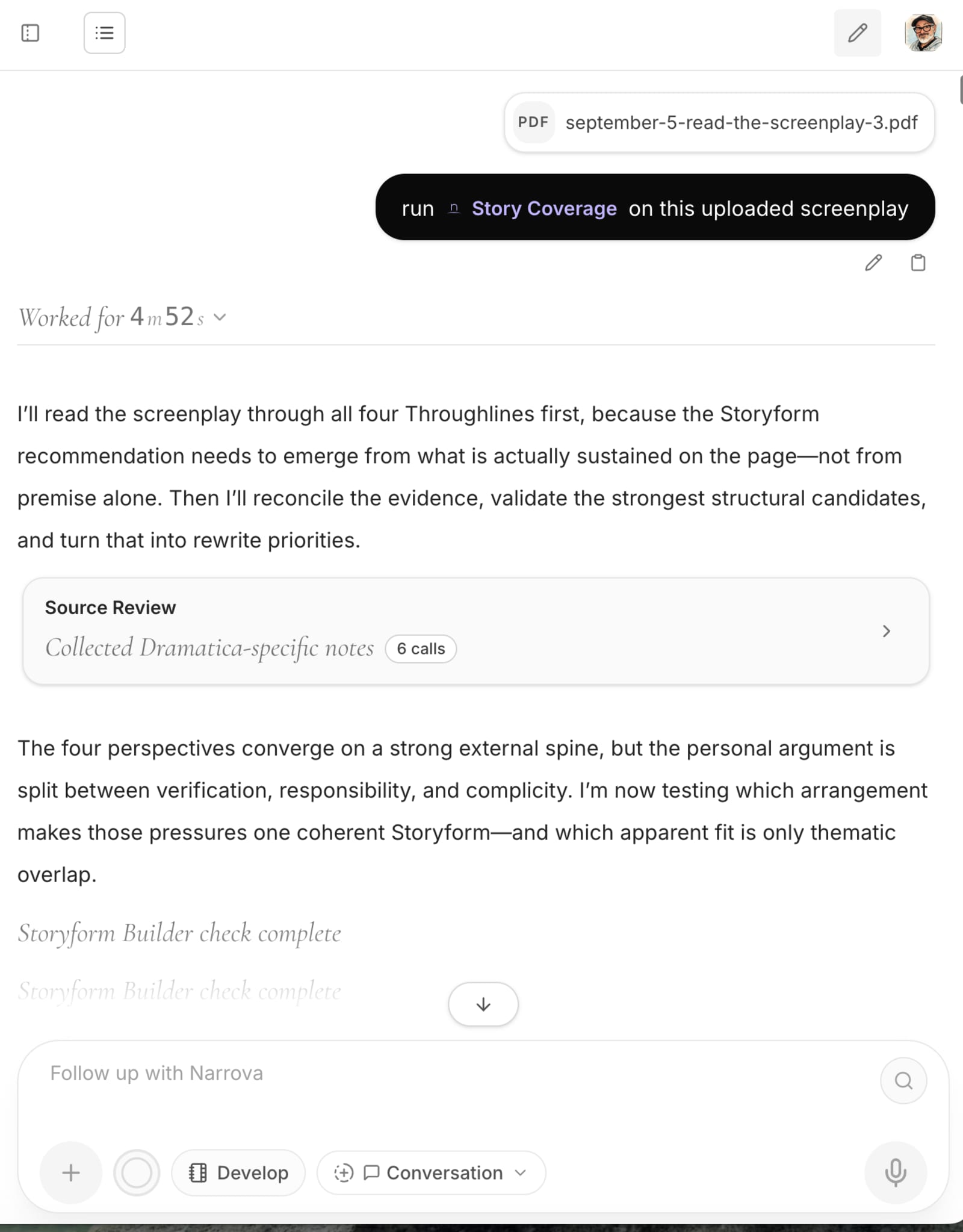
That first pass finds a strong external spine: a sports-production crew trying to carry out live news coverage while the event outruns its technology, access, verification, and judgment. The screenplay is clearly alive when people are recalling crews, finding camera positions, translating reports, securing satellite time, and deciding what can go on air. These are the problems everyone faces together, so they belong to the Objective Story Throughline.
Dramatica calls the broad source of conflict in a Throughline its Domain. The shared conflict in September 5 has the character of Physics, the Domain concerned with activity: people trying to get something done while their efforts create further trouble. Within that broad area, Doing emerges as the likely Concern, the particular activity occupying everyone throughout the story.
The personal material is harder to place. Geoff’s work dominates the plot, yet his activity in the control room may describe what the whole crew is doing rather than what Geoff alone experiences from the inside. Bader’s caution may sound like ordinary professional disagreement until it is considered as a persistent alternative to Geoff’s way of seeing the day.
This distinction is where ordinary coverage often slips. A character does something repeatedly, so the analysis assumes that activity defines the character’s personal arc. Dramatica asks whether the conflict is being observed from the outside as part of the crew’s effort or lived from the inside as Geoff’s private predicament. The same scene can carry both viewpoints, but collapsing them leaves the analysis unable to explain why succeeding at the job might still make Geoff’s personal situation worse.
Testing What Belongs Together
After the first reading, Narrova begins placing the pins. It sends each proposed arrangement to Dramatica’s Story Engine, the rule system that knows how the choices in a Storyform relate to one another. A label can sound perfect for one character and still fail if it requires the other three viewpoints to become stories the screenplay is not telling.
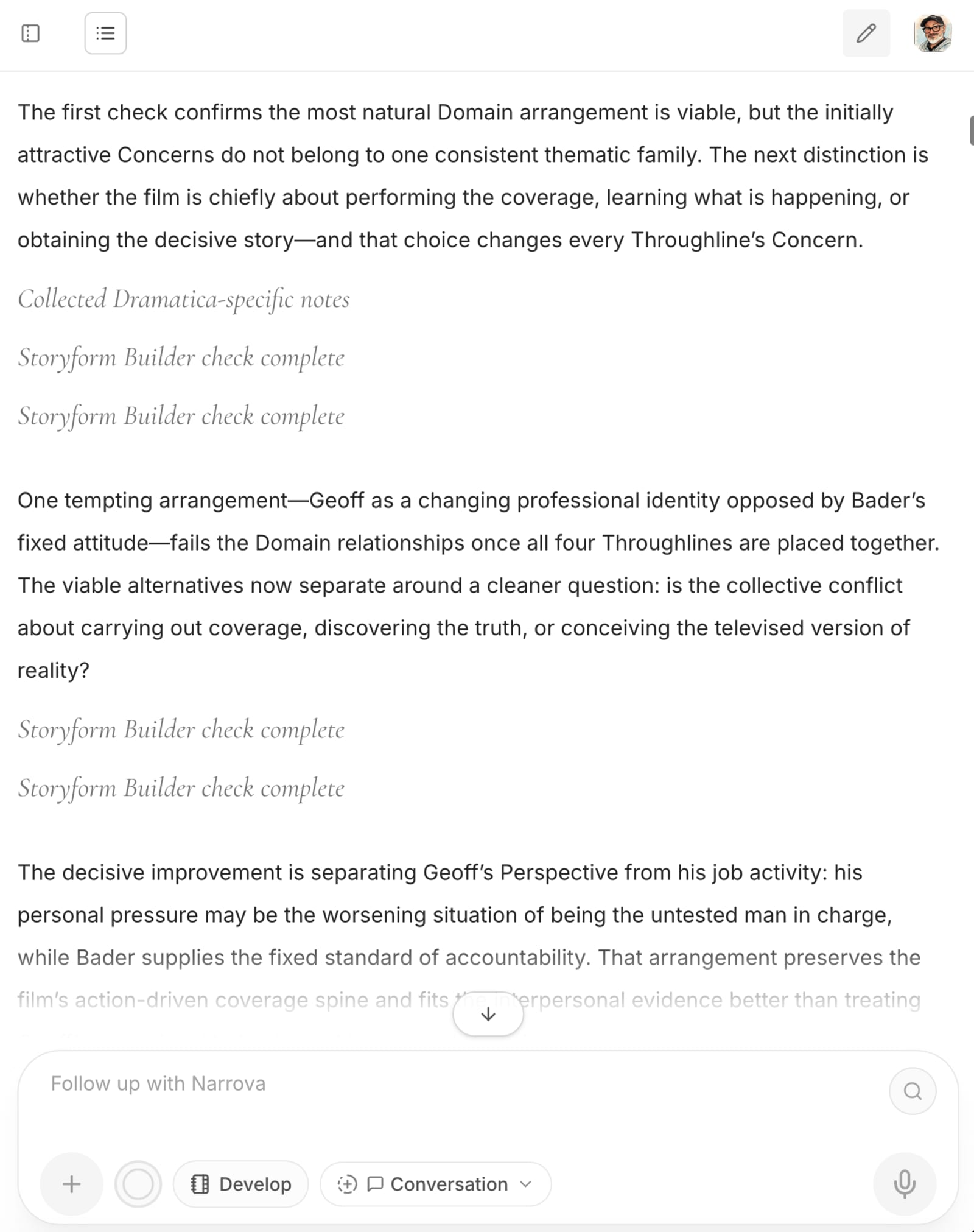
The first group of attractive choices does exactly that. Is the crew chiefly engaged in Doing the coverage, Learning what is happening, or Obtaining the decisive story? All three appear in the screenplay, and all three can generate convincing commentary. Yet each one defines the shared effort differently, changing which personal, opposing, and relational conflicts can coherently develop beside it.
Dramatica calls these named structural observations appreciations. “Learning” is more than a clever description of reporters gathering information, just as “Doing” is more than a synonym chosen because the scenes feel active. Each term occupies a defined position in the model. Choosing one makes a claim about the whole story, not merely about the scene that inspired it.
Narrova can therefore test a reading instead of becoming attached to it. One tempting arrangement treats Geoff’s changing professional identity as his personal Domain and Bader’s fixed attitude as the opposing force. It sounds right in isolation. Once all Four Throughlines are placed together, the Domain relationships fail.
“One tempting arrangement—Geoff as a changing professional identity opposed by Bader’s fixed attitude—fails the Domain relationships once all four Throughlines are placed together.”
— Narrova, September 5 Story Coverage analysis
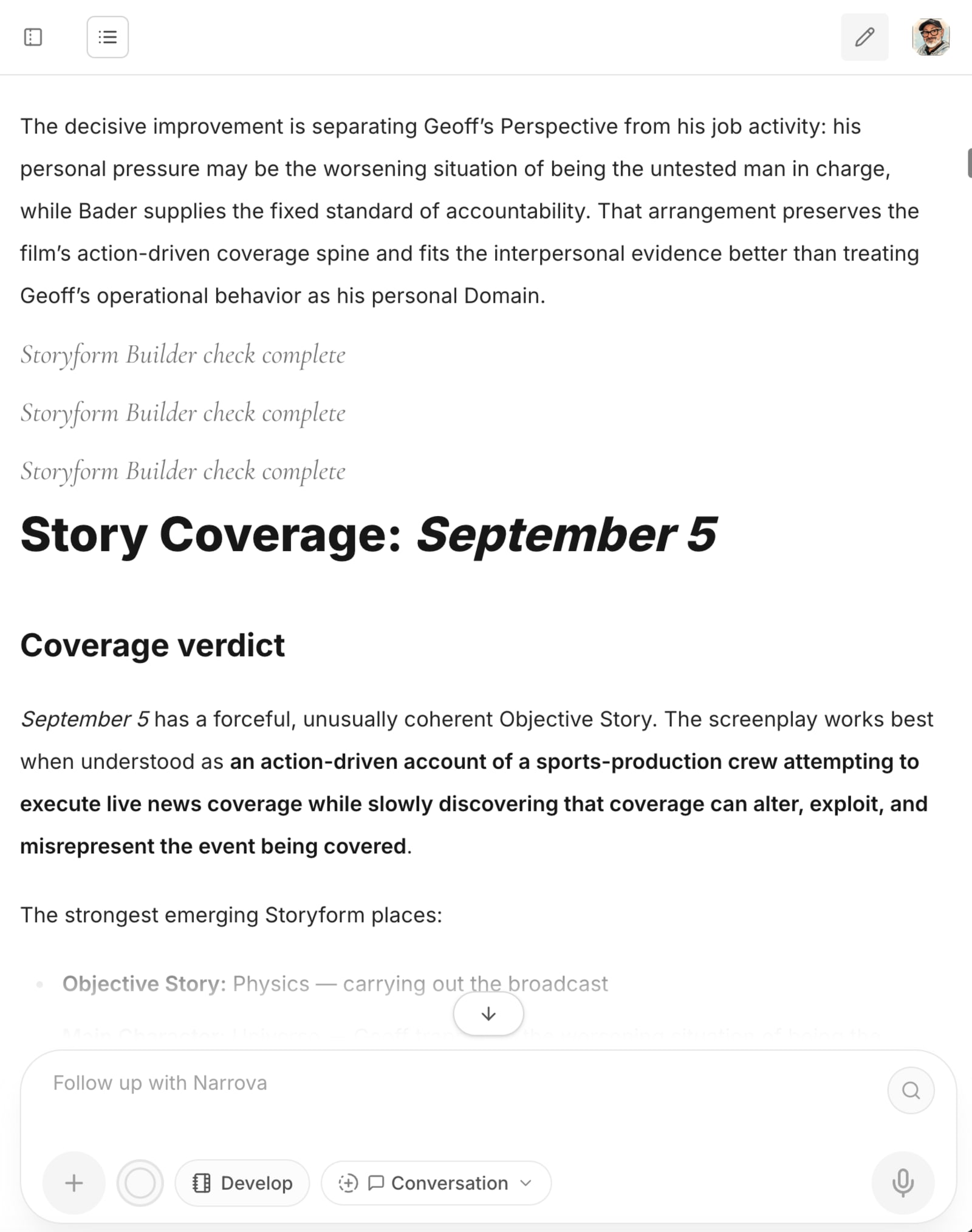
This rejection matters as much as the final recommendation. “Geoff is becoming a different kind of producer” remains a perfectly respectable observation about the screenplay. The Storyform forces the next question: can that interpretation coexist with the strongest evidence from every other viewpoint? In this arrangement, it cannot.
The better fit appears when Geoff’s personal experience is separated from his job activity. The Objective Story remains in Physics because everyone is trying to execute the broadcast. Geoff’s Main Character Domain moves to Universe, Dramatica’s Domain of situations: he is the untested man caught in a worsening position of responsibility.
Bader occupies Mind, the Domain of fixed attitudes, because his standard of accountability keeps confronting Geoff with a way of seeing the broadcast that will not simply bend to events. Geoff and Marianne’s evolving collaboration finds its place in Psychology, the Domain concerned with changing ways of thinking and relating. The arrangement preserves the action-driven experience of the screenplay while explaining why every operational victory gives Geoff greater control—and therefore greater responsibility for what the broadcast might cause.
The Kind of Objectivity a Story Needs
Story analysis will always begin with interpretation. A person—or an AI—still has to read the scenes, decide which viewpoint a conflict belongs to, and judge which moments carry the greatest structural weight. Dramatica does not pretend that evidence interprets itself.
The objectivity arrives when those interpretations meet the Story Engine. A proposed Domain either participates in a valid arrangement or it does not. A set of Concerns either belongs to the same structural family or it does not. A new choice either preserves the relationships already established or changes what the other Throughlines must become.
The reading begins as interpretation; the comparison becomes objective.
This is a more useful standard than asking whether an AI “agrees” with a reader. Narrova can state its evidence, expose the candidate it is testing, and show why one arrangement accounts for more of the screenplay than another. A writer may challenge the evidence or propose a better placement, but the conversation now concerns a shared structure rather than two impressions talking past each other.
The final report makes that discipline visible. It recommends Objective Story in Physics, Main Character in Universe, Influence Character in Mind, and Relationship Story in Psychology. These four Domains fit together, explain the conflict already present in the draft, and give the analysis a coherent foundation. They do not complete the Storyform.
“That configuration validates as structurally viable. It is not yet a complete Storyform: 512 possibilities remain, principally because Resolve, Outcome, Judgment, Issues, and Problems are not decisively established.”
— Narrova, September 5 Story Coverage report
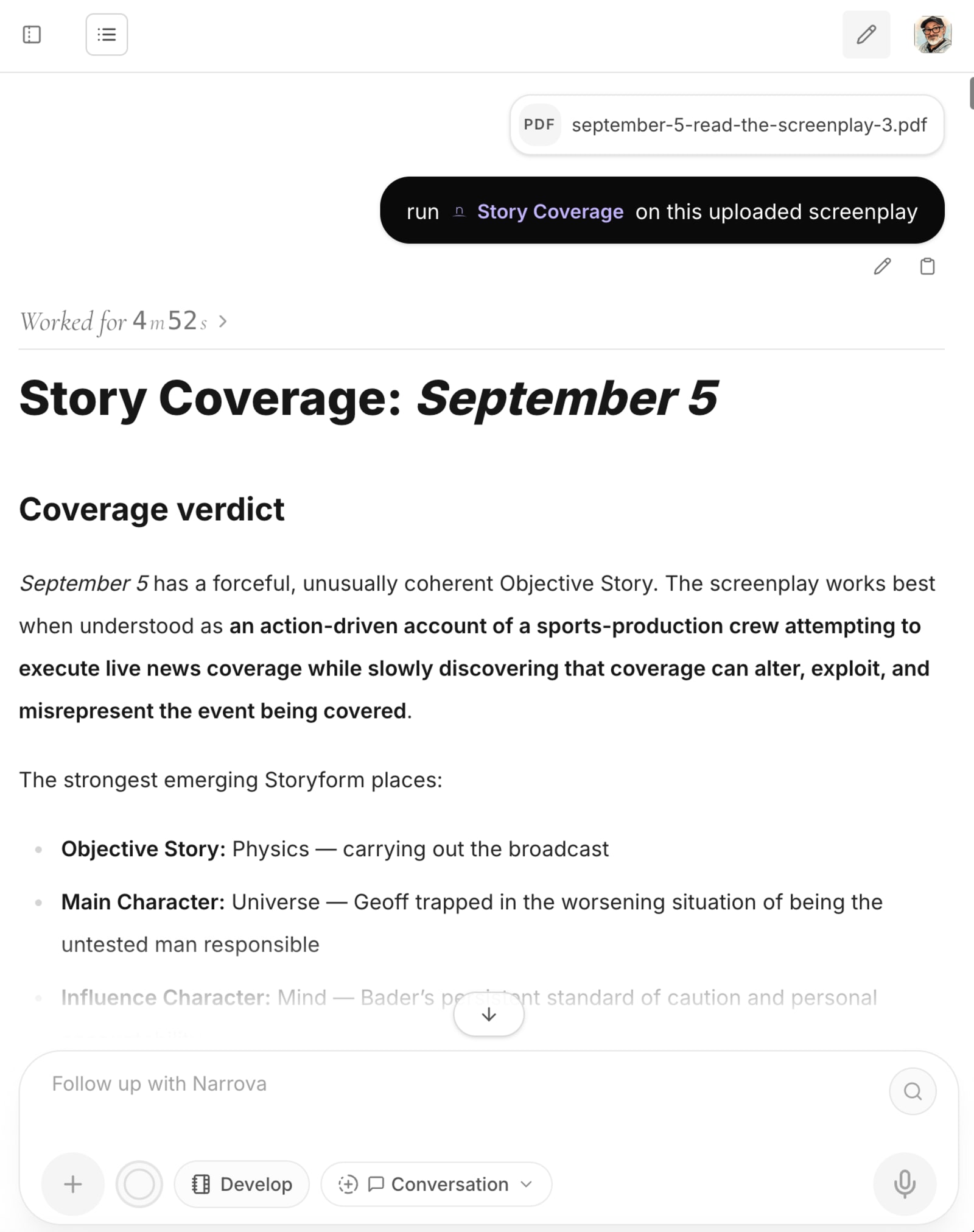
The 512 possibilities are the valid Storyforms still available after the strongest choices have been placed. That number is an honest account of what the screenplay has and has not supplied. The Domains are strongly supported, while several other choices remain open because the draft does not yet make them decisive.
An AI without a Storyform can conceal this uncertainty beneath fluent confidence. It can choose a theme, describe a character arc, and make every paragraph sound inevitable. A structurally grounded AI has a harder and more valuable job: it has to preserve the difference between what the screenplay demonstrates, what the analyst infers, and what the story has left unresolved.
Finding the Story Hole
The deepest note in the coverage comes from recognizing a missing relationship in the Storyform. The screenplay does not simply lack an event or a line of explanation. It has carried several parts of its argument to the ending without yet showing how they resolve together.
The screenplay gives Geoff devastating information at the end: the hostages are dead. The crew’s apparent triumph collapses, and Marianne observes that they waited because they wanted a picture. Geoff feels the consequence of the day, but the draft does not show whether that knowledge fundamentally changes how he meets the conflict or whether he remains Steadfast in the approach that brought him here.
Dramatica calls that choice the Main Character’s Resolve: Change or Steadfast. The ending also leaves his Judgment uncertain, because we cannot yet tell whether his personal struggle has been brought to a good end or remains unresolved. Both appreciations turn a general feeling of ambiguity into questions the writer can deliberately answer.
The Objective Story Outcome is unsettled as well. The crew stays on the air and gets the story first, yet it fails to report the liberation accurately. Until the screenplay decides what success means, its larger question—whether responsible coverage can remain truthful without becoming part of the spectacle—cannot receive a decisive answer.
Ordinary coverage might call the ending powerful but ambiguous. The Storyform shows where the ambiguity lives and what else it affects. A single costly action from Geoff could clarify several relationships at once: he might insist on confirmation despite losing the scoop, refuse an exploitative image, accept responsibility in public, or continue the work under a principle the screenplay has made unmistakable.
Dramatica leaves the ending in the writer’s hands while making the decision visible. Storyform appreciations act as useful pins because they isolate the conflict already present and reveal the negative space around what is missing. A story hole may look like an empty beat or an absent explanation on the surface; underneath, it is often a relationship the draft has implied without bringing fully into view.
The Storyform Is the Point
There is a temptation to hide all of this machinery in the name of making AI feel effortless. Let the system read the screenplay, deliver the verdict, and spare the writer the complication of learning how the conclusion was reached. The result may sound authoritative while giving the writer no way to question it.
The pins are where the meaning is. If the system chooses them invisibly, the writer receives conclusions without understanding the argument beneath them. When the system brings them into view, the writer can see why one interpretation survived, why another failed, and where the screenplay has not yet supplied enough evidence. The Storyform becomes a shared object the writer can question, correct, accept, or refuse.
This preserves the writer’s authority. Narrova can read across hundreds of pages, hold the four viewpoints in context, compare combinations in the Story Engine, and notice relationships that are easy to lose inside the momentum of a draft. It can make the analysis rigorous, but it cannot decide what September 5 should finally mean.
That last movement belongs to the writer. The Storyform gives them a clear view of the argument taking shape and the holes still running through it. Then the writer returns to Geoff, Marianne, Bader, the control room, the terrible uncertainty at the airport—and brings the missing choice to life with action, image, silence, and consequence.