Christopher Nolan Is Right: Seeing the Structure Doesn’t Break the Story
Recognizing how a story moves us does not cancel the experience. Christopher Nolan’s comments on storytelling, Memento, and The Odyssey reveal the practical distinction between a Storyform and the storytelling built from it.
There is a peculiar moment in the life of every serious story student when the machinery becomes visible.
You notice the turn before it arrives. You recognize the scene designed to win sympathy for a difficult character. You can feel the climax gathering its forces. A choice that once seemed mysterious now looks like part of a pattern, and for a moment the pleasure of the story gives way to the pleasure of diagnosis.
Then comes the temptation: because you can see how the story works, you decide it did not work on you.
Christopher Nolan has little patience for that move. In a recent conversation about The Odyssey, film criticism, and the conventions filmmakers inherit from one another, he offered a compact defense of storytelling craft:
“To be able to identify the mechanism does not invalidate the mechanism.”
— Christopher Nolan, interview with Zhong Shu, August 2026
That sentence reaches well beyond film criticism. It goes straight to the anxiety many writers feel around story structure—and especially around Dramatica. If a story can be described as a system, does that make it mechanical? If its effects can be traced to structural choices, does that make the feeling less authentic? If we know the Storyform in advance, have we reduced the living work to a formula?
No. We have simply learned where to look.
Recognition is not the same as judgment
Nolan’s complaint is aimed at a familiar style of criticism. A viewer recognizes that a filmmaker has made a character sympathetic, identifies the scenes or choices responsible for that sympathy, and treats the discovery as evidence against the film. The mechanism has been exposed, so the effect is assumed to be false.
But every story reaches us through mechanisms. Point of view is a mechanism. Suspense is a mechanism. Revealing one piece of information while withholding another is a mechanism. So are contrast, repetition, expectation, reversal, dramatic irony, and the decision to let us experience a conflict from inside one character while observing another from the outside.
Calling those choices mechanisms does not empty them of meaning. It gives us a way to ask whether they carry the meaning the storyteller intended. Sympathy can be cheaply purchased, honestly earned, strategically complicated, or deliberately refused. Identifying its construction begins the critical conversation; it does not settle it.
This is where structural vocabulary earns its place. A weak analysis points at a recognizable device and declares victory. A useful analysis follows the device into the story’s larger argument. Why does the audience need to care about this person? Which Perspective are we being asked to inhabit? What pressure does that identification place on the way we understand everyone else?
Dramatica was built for those questions. Its purpose is not to congratulate us for noticing the gears. It is to help us understand how the gears turn together.
The familiar structure beneath the unfamiliar film
Nolan makes the point concrete with Memento. The film runs backward through its color sequences, denying the audience the ordinary security of cause followed by effect. Each new scene changes our understanding of the scene we just watched. Chronology becomes disorientation because we are forced into Leonard’s condition: we know what is happening now without knowing what produced it.
That surface design still needed something stable beneath it. Nolan says he retained a clear three-act shape so the audience could receive the film through a familiar dramatic movement even while experiencing its events in an unfamiliar order. His formulation is almost a description of the relationship between Storyform and Storytelling:
“Extremely familiar underneath so that I can change what’s on the surface.”
— Christopher Nolan, interview with Zhong Shu, August 2026
In Dramatica, a Storyform is the underlying structural argument of a complete story. It holds the relationships among the story’s central inequity, its four Throughlines, its dramatic concerns, and the choices that determine how the argument resolves. Storytelling is the expression of that structure: the characters, settings, chronology, imagery, dialogue, genre, tone, and scenes through which we encounter it.
The distinction matters because the surface is where invention becomes visible. Reverse the chronology. Tell the story through testimony, memory, dreams, documents, or contradictory narrators. Place an ancient argument inside a science-fiction world. Turn a family drama into a ghost story. Change every image and incident while preserving the structural relationships that keep the experience coherent.
A Storyform does not tell a writer to make Memento. It cannot supply that film’s fractured editing, its Polaroids, its motel rooms, or Guy Pearce’s wounded certainty. What it can do is describe the deeper relationships the storytelling must sustain if all that formal invention is going to land as one meaningful experience rather than a clever arrangement of scenes.
Structure, in that sense, is not the opposite of originality. It is often what makes originality survivable.
The canonical Memento Storyform in Dramatica makes that hidden stability available for inspection. Its Thematic Argument distills the story this way:
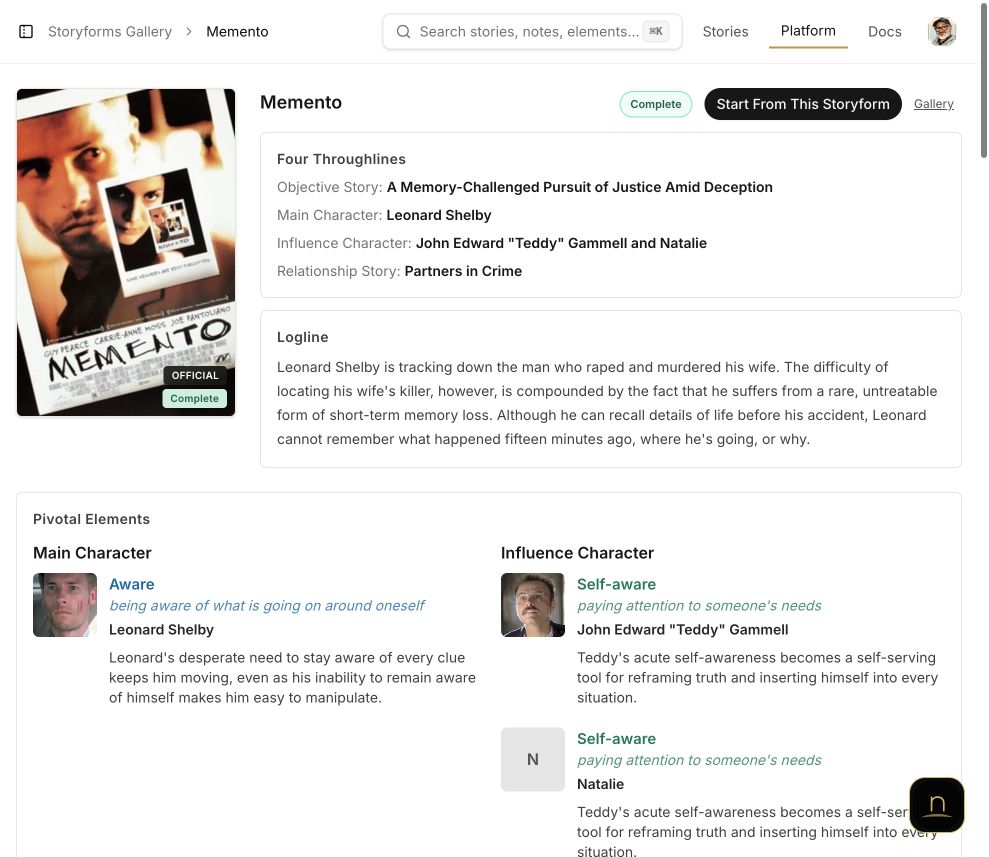
The canonical Memento Storyform in production.
Clinging to whatever proof can still be shown may win an explanation, but it warps fairness into a private rationale; accepting an unfair outcome to satisfy a deeper want keeps the truth from turning hollow.
— Thematic Argument, Memento Storyform
Notice what the argument does not mention. There are no reverse-running scenes, Polaroids, tattoos, motel rooms, or gaps in Leonard’s memory. Those belong to the film’s brilliant Storytelling. The Thematic Argument reaches beneath them to the conflict those choices express: the seduction of demonstrable proof, the private rationale it can support, and the hollow truth waiting beneath Leonard’s pursuit. The formal mechanism and the structural meaning are not competitors. The first is how we are made to experience the second.
The audience brings part of the story with them
Nolan repeatedly returns to the audience in the interview. Filmmakers inherit a common language built through a century of cinema: the language of genre, sympathy, narrative direction, and clarity. Audiences arrive already fluent in much of it. They recognize a threat before anyone names it, understand what a cut is asking them to connect, and carry expectations about heroes, monsters, love stories, mysteries, and endings into the theater.
Those expectations create pressure. A storyteller can honor them, redirect them, bend them, or break them, but cannot pretend they are absent. Even a work that announces itself as radically original enters into a conversation with everything the audience has already learned about stories like it.
Dramatica approaches that exchange through four distinct Perspectives. The Objective Story lets us observe the conflict affecting everyone. The Main Character gives us the first-person experience of a personal inequity. The Influence Character challenges the Main Character’s way of seeing that inequity. The Relationship Story lets us experience the bond between them as a source of conflict in its own right.
These Perspectives help explain why “make the hero sympathetic” is such a poor substitute for actual analysis. Sympathy may draw us toward the Main Character, but sympathy does not determine the character’s objective role, prove the correctness of their worldview, or tell us what the story ultimately argues. A charming Protagonist can pursue a destructive goal. A difficult Main Character can occupy the emotional center of a story. An Influence Character can exert tremendous pressure without behaving like a conventional antagonist.
The mechanism of identification matters because it determines where the audience stands while the argument unfolds. Once we know where we are standing, we can ask what the story allows us to see—and what our position encourages us to overlook.
That is a much more interesting critical act than catching the filmmaker in the use of sympathy.
What changes inside a person may not change the world
The most revealing part of Nolan’s conversation may be his discussion of atonement in The Odyssey. Zhong Shu presses him on the modern quality of Odysseus’s apparent need for repentance, suggesting that the film brings a later moral sensibility to a Greek story. Nolan’s response separates two effects that audiences often collapse into one.
Odysseus may confess. He may become more honest with Penelope. The audience may experience catharsis in that intimacy. Yet the damage already done to the world remains done. Civilization may still be heading toward catastrophe, and an internal reckoning does not reverse an external collapse.
Dramatica gives that distinction a precise home. The Main Character Throughline asks what the conflict feels like from inside the person at the center of the audience’s experience. The Objective Story Throughline asks what is happening in the larger effort shared by everyone. A personal resolution and an objective result can affect one another, but they are not the same measurement.
This is why Dramatica separates Judgment from Outcome. Outcome asks whether the Objective Story effort succeeds or fails. Judgment asks whether the Main Character’s personal struggle resolves as good or bad. A story can end in Success while leaving its Main Character internally devastated. It can end in Failure while allowing the Main Character to arrive somewhere personally whole.
That separation does not tell us the Storyform of Nolan’s The Odyssey by itself. Nor should one interview answer that question for us. It does, however, show the value of refusing to treat “the ending” as a single undifferentiated verdict. Odysseus can find a moment of personal honesty while the consequences of his actions continue beyond him. The emotional release is real, and so is the catastrophe it cannot undo.
Our canonical Storyform for Nolan’s The Odyssey, now in production, carries that distinction through a complete structural reading. Its Thematic Argument arrives at a related but more specific claim:
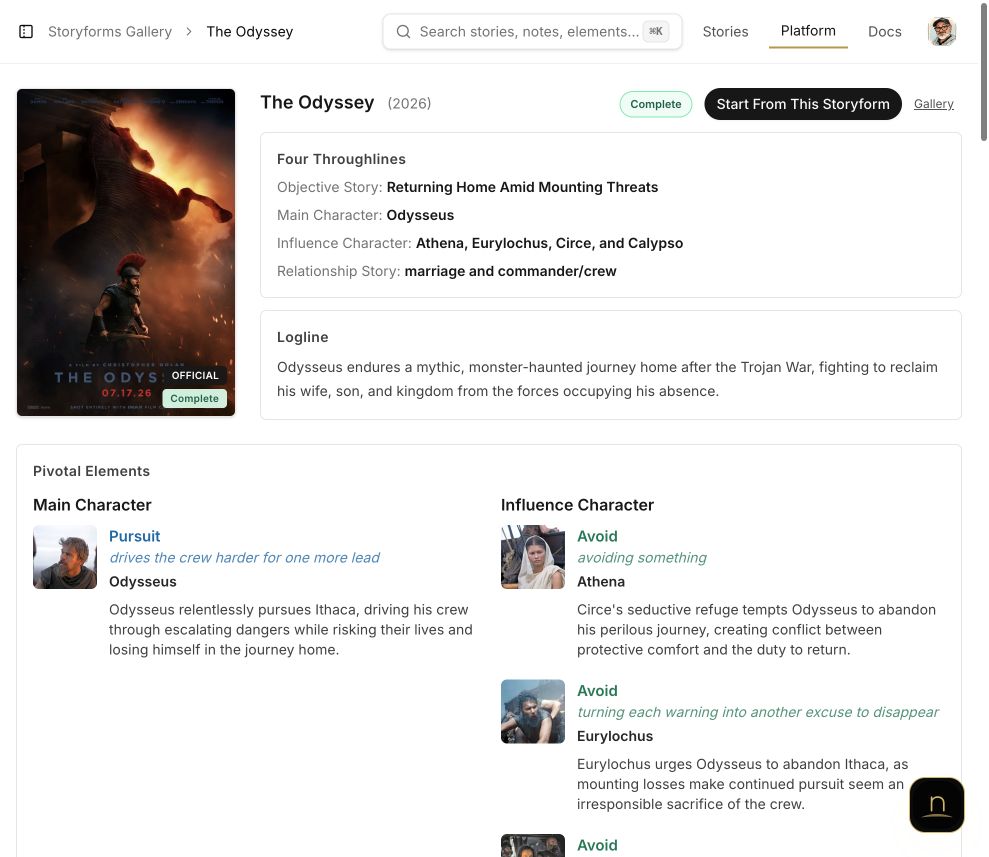
The canonical The Odyssey Storyform in production.
When the drive to press on for one more opening turns into an endless chase, the very future being fought for keeps slipping further away; only by choosing not to pursue every tempting path forward can a delayed return become a real homecoming and restore what comes next.
— Thematic Argument, The Odyssey Storyform
Here the homecoming is not merely the reward at the end of an adventure. It becomes the proof of a changed way of moving through the world. The production Storyform reads Odysseus as Change, with an Objective Story Outcome of Success and a Main Character Judgment of Good. That combination preserves Nolan’s distinction: the larger effort can reach its destination while the personal resolution measures whether Odysseus has finally stopped turning every possible opening into another reason not to come home.
Knowing that these effects belong to different Throughlines sharpens the experience. It does not diminish it.
Dramatica is useful because the mechanism can be questioned
Writers sometimes fear that structural analysis will tell them their instincts are fake. Usually it does something more generous. It shows them which instinct belongs to which part of the story.
The writer who wants an unresolved plot and an emotionally healing ending may be holding a Failure/Good story. The writer who loves a protagonist’s actions but cannot feel the character’s personal journey may have developed the Objective Story while leaving the Main Character Throughline thin. The writer whose scenes all seem individually effective but collectively meaningless may have storytelling mechanisms without a coherent structural argument connecting them.
Those are not prescriptions. They are diagnoses. Dramatica does not say that every character must be likable, every convention obeyed, or every audience expectation satisfied. It asks the writer to become conscious of the relationships created by those choices and to understand what changes when one of them moves.
That consciousness becomes especially valuable when convention is being broken. A writer who understands which part of the experience provides orientation can disrupt chronology without disrupting meaning. A writer who understands the four Perspectives can shift sympathy without confusing objective function. A writer who separates personal Judgment from objective Outcome can create an ending whose emotional truth complicates its visible result.
The mechanism becomes a tool for freedom because the writer can finally choose what to preserve.
Seeing the structure gives us more to feel
There will always be a version of criticism that mistakes detection for insight. It names the trope, identifies the beat, points to the manipulation, and assumes the story has been emptied by exposure. That posture feels sophisticated because it remains one step ahead of the experience. It is also a reliable way to stop experiencing anything.
Stories are made things. Their construction does not disqualify their emotional truth any more than understanding harmony disqualifies music. The useful question is whether all that construction produces a coherent experience—whether the choices of Perspective, conflict, expectation, and resolution gather into an argument the audience can feel.
This is the promise of a Storyform. It makes the underlying relationships visible enough to examine, develop, and revise. It lets the writer preserve what is essential while transforming everything through which that essence is expressed.
Nolan’s work has always lived in that tension. The chronology can run backward. Time can fold across dreams, memory, gravity, and war. A familiar myth can be retold through a modern understanding of catastrophe and remorse. The surface can keep changing because something underneath continues to orient the audience.
Seeing that structure does not break the story.
It lets us see how much the story is carrying.
Sources
- Leonard Pearce, “Christopher Nolan on the Flaws of Film Criticism and the Shared Philosophy of Oppenheimer and The Odyssey”, The Film Stage, August 1, 2026.
- Zhong Shu, “Christopher Nolan Talks Narrative Decisions, Film Critics and Whether He Christianised The Odyssey”, August 2026.
- Dramatica, canonical Memento Storyform.
- Dramatica, canonical The Odyssey Storyform.
- Dramatica, “Of Stories and Storyforms”.
- Dramatica, “The Storyform”.