Ninety Degrees from Ithaca: Spider-Man, The Odyssey, and the Summer of Hopecore
The two biggest films of summer 2026 look nothing alike, yet their canonical Storyforms share the same Influence Character and Relationship Story Problems. That structural rhyme tells us something about what audiences are searching for now.
Something strange happened when we placed The Odyssey and Spider-Man: Brand New Day beside one another in the Dramatica canonical library.
At first, we thought something was broken.
These are two very different movies. One follows a dispossessed king fighting his way home through gods, monsters, and the consequences of his own actions. The other follows a young man who has cut himself out of everyone’s life, burying Peter Parker beneath Spider-Man while Damage Control tries to contain and exploit powers it cannot understand. One reaches back almost three thousand years. The other arrives wrapped in the most modern form of cinematic mythology we have.
And audiences have embraced both with startling force. As of August 9, Brand New Day had made $1.67 billion worldwide in ten days, becoming the highest-grossing film of 2026 after only one week. The Odyssey had crossed $1.1 billion, becoming Christopher Nolan’s biggest global box-office success and the highest-grossing domestic IMAX release of all time. Together, the films have helped drive Hollywood toward its strongest year since the pandemic (Associated Press).
Their success already tells us that people want to go back to the movies. Their Storyforms suggest something more interesting: they tell us what people are hoping to find when the lights go down.
Spoilers follow for both The Odyssey and Spider-Man: Brand New Day.
The discovery that looked like an error
Every complete Storyform examines conflict through four simultaneous Perspectives. The Objective Story Throughline gives us the view from the outside, where everyone is involved in the larger conflict. The Main Character Throughline gives us the personal, first-person experience. The Influence Character Throughline challenges that personal point of view, while the Relationship Story Throughline holds the conflict growing between the Main Character and the person—or people—carrying that influence.
In the canonical Storyform for The Odyssey, the Objective Story sits in Universe. A king is out of place. Ithaca is left without its rightful ruler, Penelope is surrounded by suitors, and every delay in Odysseus’s return allows others to shape the kingdom’s future. The external conflict grows from a situation that has to be restored.
Odysseus’s personal Throughline sits in Physics. His trouble comes through activity: making another plan, taking command, fighting harder, and doing what he shouldn’t. Shooting the Cyclops is only the most spectacular example. His Main Character Problem is Pursuit, the drive to seize his old life through force of will even when that very drive carries him farther from home.
Spider-Man: Brand New Day turns those Perspectives ninety degrees off-center. Its Objective Story is in Physics: Damage Control’s experiments, its efforts to suppress and study superhuman powers, Jean Grey’s campaign against the system, Frank Castle’s pursuit of justice, and Spider-Man’s attempts to stop the city from tearing itself apart. The shared conflict comes from what everyone is doing.
Peter Parker’s Main Character Throughline is in Universe. May is gone. MJ and Ned no longer remember him. Peter has made himself into a man apart, isolated from ordinary human connection and increasingly buried beneath Spider-Man. His personal Problem is Control: the belief that he can keep everyone safe by controlling the distance between himself and the people he loves.
So far, everything is different. Universe and Physics have exchanged places. Pursuit in The Odyssey has become Control in Brand New Day. Odysseus keeps doing; Peter keeps himself apart.
Then we reached the other two Throughlines.
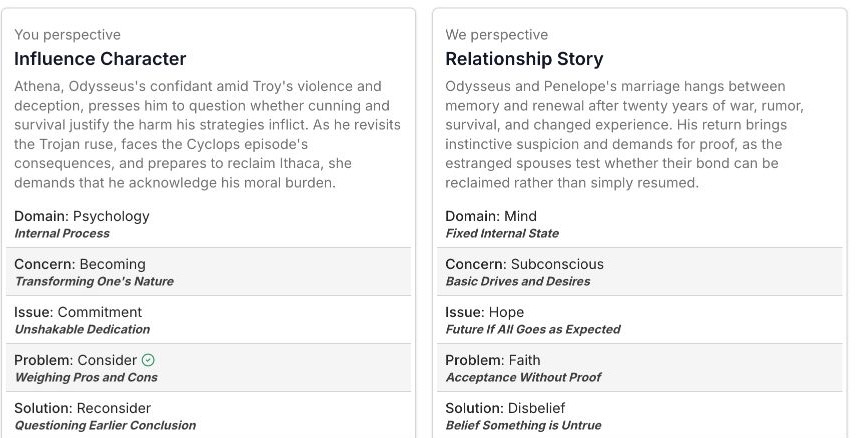
The adjacent Influence Character and Relationship Story Throughlines in the canonical The Odyssey Storyform.
Both films have an Influence Character Problem of Consider.
Both films have a Relationship Story Problem of Faith.
The paired Solutions are identical as well: Reconsider for the Influence Character Throughline and Disbelief for the Relationship Story Throughline. The software wasn’t broken. Two of the largest films in the world were exploring different external and personal conflicts while turning around the same challenge and the same emotional center.
A Storyform is a complex web of interrelated thematic touchpoints, each one taking its meaning from the complete argument around it. With 32,768 possible Storyforms, finding two films whose Objective Story and Main Character Throughlines have traded Domains while their Influence Character and Relationship Story Problems remain exactly aligned is a genuinely wild occurrence. This isn’t the sort of match we expect to uncover every day, and it certainly isn’t the norm. That Consider and Faith survived the ninety-degree turn makes the resemblance more than a clever structural coincidence: two distinct complete stories arrived at the same challenge to the self and the same source of conflict between people.
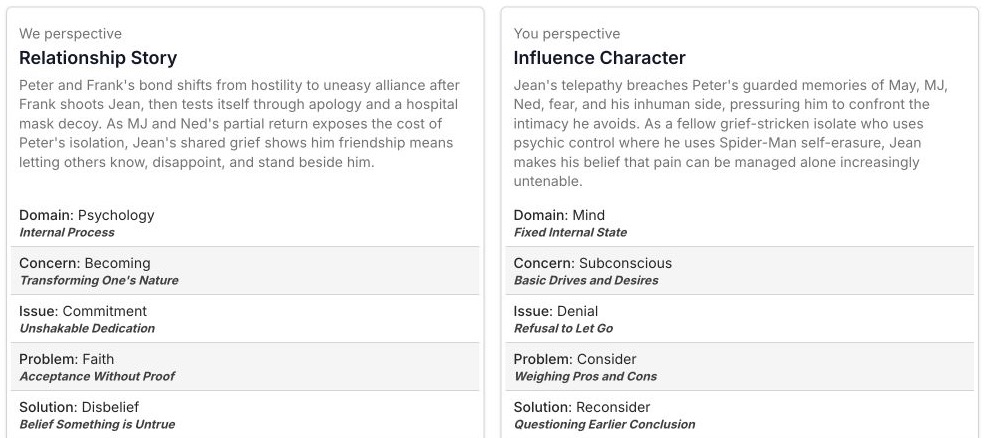
The same two Problems and Solutions appear in the canonical Spider-Man: Brand New Day Storyform, even though the Throughline Domains have rotated.
The invitation to Consider
In Dramatica, a Problem identifies a source of conflict. Consider isn’t a polite pause for reflection. It’s the persistent act of weighing the options, entertaining another possibility, and holding a choice open long enough for doubt to enter. In the Influence Character Throughline, that conflict arrives through the Perspective that makes the Main Character check in with themselves.
Athena carries that Perspective in The Odyssey. She keeps asking Odysseus to look beyond the necessity he claims for each strategy and face what those strategies have done. Eurylochus brings the human cost of command into the same argument. Circe exposes the appetite beneath the heroism. Calypso makes the alternative almost unbearable in its completeness: safety, desire, forgetfulness, and release from duty.
“Her presence asks whether he truly wants to return home, or whether he only wants the idea of being the man who returns.”
— Calypso Perspective, the canonical Odyssey Storyform
Each of them makes Odysseus Consider. Is this plan necessary? Is command the same as leadership? Is home what he wants, or is it the identity of the returning king? The Influence Character Throughline keeps reopening questions that Pursuit would rather settle through action.
Jean Grey does the same to Peter through intimacy. Her telepathy reaches the place where he has hidden May, MJ, Ned, his anger, and the increasingly inhuman part of himself. She forces him to Consider whether pain can really be managed alone. Because Jean has also turned grief into isolation, she doesn’t challenge Peter from a safe distance; she embodies what his choice looks like when carried to another extreme.
Frank Castle takes up that influence after Jean opens Peter’s emotional defenses. Frank weighs the choices Peter wants to keep morally clean: restraint or lethal action, isolation or shared responsibility, righteousness or consequence. Peter rejects Frank’s methods, but he can’t dismiss the question Frank represents. What happens when one person insists on carrying every impossible decision alone?
“Friendship does not mean agreement; it means allowing another person to matter, to fail, to be answered for, and sometimes to help carry him home.”
— Frank Castle / the Punisher Perspective, the canonical Brand New Day Storyform
That final phrase brings the two films unexpectedly close. Athena and Jean Grey, Calypso and Frank Castle all keep another possibility alive. Their methods, morality, and relationships differ wildly, but the structural source of conflict is the same. They make the Main Character weigh the life they’re pursuing against the life they might choose instead.
Faith at the heart of both stories
The deeper alignment lives in the Relationship Story Throughlines. Both films place Faith at the source of conflict between people who remain bound to one another across absence, disappointment, and change.
For Odysseus and Penelope, Faith spans twenty years. Their marriage survives as memory, rumor, hope, and an idea of the people they once were. His return can’t simply reset the relationship. Suspicion and the demand for proof enter precisely because so much Faith has been asked of them for so long.
That is the curious thing about a Relationship Story Problem of Faith. Faith is beautiful, and an abundance of it can still create conflict. Belief can preserve a marriage across impossible distance, but it can also preserve an image of another person long after experience has changed them. The relationship has to discover whether husband and wife can recognize one another again, not merely whether each kept believing.
The primary Relationship Story pair in the canonical Brand New Day Storyform is Peter and Frank. Their bond moves from hostility to alliance, through Frank’s shooting of Jean, rupture, apology, and the hospital mask decoy. MJ, Ned, and Jean intensify that same relationship space by showing Peter what friendship costs when he tries to preserve it from afar.
This is where the film’s ending becomes so painful. MJ gives the Relationship Story Solution of Disbelief a voice when she tells Peter she isn’t the same MJ who fell for him and that they won’t be together. The scene lands because Disbelief answers a relationship overwhelmed by Faith. It breaks the promise that love alone can restore people to who they were.
Then Peter and Ned return us to the Problem. Their handshake reaches back toward the original Faith between friends—the belief that, somehow, they come back to one another. The film doesn’t make the Solution comfortable or the Problem worthless. It lets us feel why Disbelief can release one relationship while Faith can still make another worth fighting for.
That complication is the heart of both movies. Penelope’s Faith is neither naïveté nor passive waiting. Peter and Frank’s Faith isn’t uncomplicated loyalty. These relationships hurt because belief matters, and because the people we believe in can return altered, disappoint us, or ask us to recognize that what we hoped for no longer exists in the same form.
Hopecore reaches the cinema
There’s a word for the wider cultural movement gathering around this desire to believe: hopecore. It began as a style of online content built from optimistic images and messages, a deliberate answer to the negativity of the doomscroll (Cambridge Dictionary). By 2026, researchers were finding that hopecore’s sincere, positive orientation could produce genuine feelings of hope through stories of kindness, flawed beauty, self-knowledge, and emotionally constructive sharing (Journal of Documentation).
The easy version of hopecore is uplift. The more interesting version is the search for something sturdy enough to believe in. Audiences aren’t asking stories to pretend the world is fine. They’re looking for a greater belief they can point toward after the story has acknowledged grief, isolation, violence, moral compromise, and the possibility that the person who returns may not be the person who left.
That longing runs through the films we’re embracing. The Odyssey gives it the scale of myth: the belief that home can still mean something after war has transformed everyone involved. Brand New Day gives it the scale of friendship: the belief that human connection remains possible after Peter has erased himself from the lives of the people he loves.
The Dramatica structure reveals why these films can feel joined even when their storytelling is worlds apart. Their Objective Story and Main Character Perspectives explore different kinds of conflict. Their Influence Characters keep asking the same kind of question, and their relationships keep returning to the same dangerous, necessary belief.
From Learning to Obtaining
We’ve seen this kind of structural clustering before. Over long stretches of time—roughly twenty-year movements—the center of narrative attention seems to migrate around the Dramatica Table of Story Elements. Major films and Best Picture winners once gathered with striking regularity around Learning. Today, the center has moved decisively toward Obtaining.
That shift makes intuitive sense. Learning stories are concerned with gathering information, discovering how things work, and taking in what has been hidden. Obtaining stories turn toward getting or losing what matters: a home, a relationship, an identity, justice, power, or a future. They speak to a culture less convinced that one more piece of information will save it and more concerned with whether anything meaningful can still be reached and held.
Hopecore belongs to that movement. Hope becomes concrete when someone has something to return to, someone to stand beside, or some greater belief they can carry out of the dark. Faith alone can become a Problem; Disbelief may be necessary; Consider can keep every option painfully open. Still, these stories move toward the possibility that connection, home, and meaning can be found again.
Dramatica theory is one way of understanding the narratives that drive us, light us up, and send us back to the theater. It doesn’t reduce the wonder of The Odyssey or Brand New Day to matching boxes in a chart. It lets us see the shape beneath two very different experiences—and recognize that the shape belongs to us as much as it belongs to them.
For our part, we’re thrilled to see audiences embracing great storytelling with this much enthusiasm. We’re even happier that the stories filling theaters aren’t offering empty reassurance. They’re asking whether belief can survive reality, then giving us a place to sit together while we find out.
The cinema has always been where our dreams come to light. In the summer of 2026, we seem ready to believe in them again.
Sources and Storyforms
- Jake Coyle, “‘Spider-Man: Brand New Day’ keeps record pace, ‘The Odyssey’ sets new high for Nolan”, Associated Press, August 9, 2026.
- Rachel Typrin and Tim Gorichanaz, “‘Needed this’: understanding hopecore content and engagement on Instagram”, Journal of Documentation, March 10, 2026.
- Cambridge Words, “New words — 13 October 2025”.
- Dramatica, canonical The Odyssey Storyform.
- Dramatica, canonical Spider-Man: Brand New Day Storyform.